About Calliphora quadrimaculata (Swederus, 1787)
Immature morphology: The larvae of the blue blowfly Calliphora quadrimaculata consist of a head, three thoracic segments, and eight abdominal segments. The head is often so small that it is hidden within the thoracic segments; it bears two lobes, a pair of antennae, and a pair of bristle-like maxillary palps attached to the mouthparts, which act as additional sensory structures. The mouth is located on the lower front portion of the head and has a pair of hardened mouth hooks. The oral sclerite of C. quadrimaculata is shorter than that of other species in the same family. A pair of spiracles is located on the first thoracic segment, and all body segments are separated by narrow spines. These spines are very large in C. quadrimaculata, and this trait is a key identifying feature of the species in its larval stage.
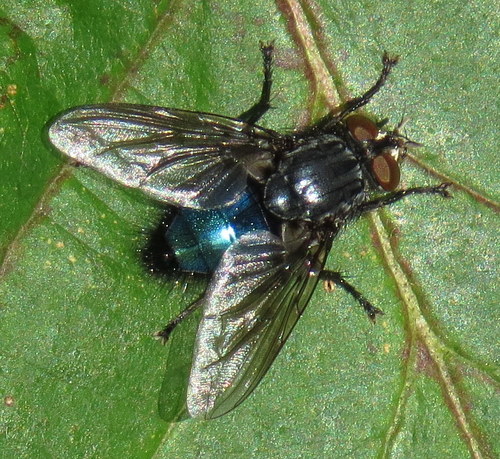
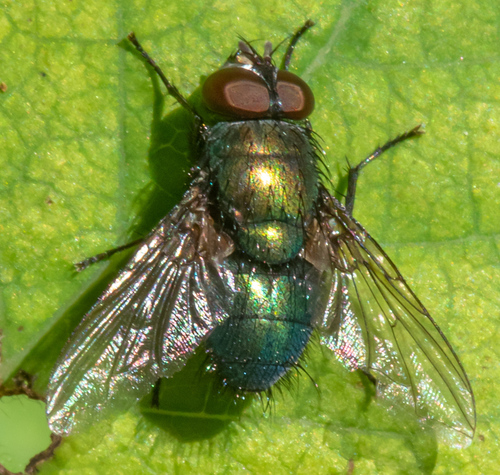
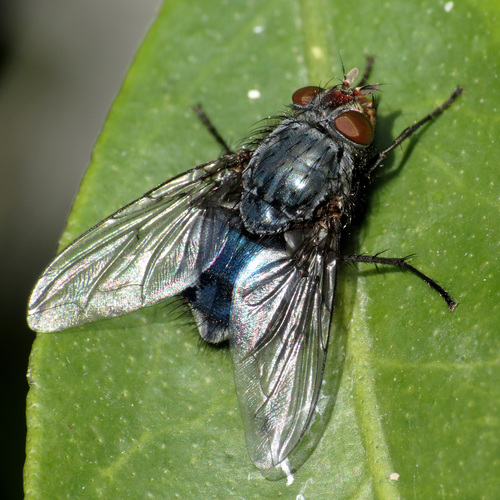
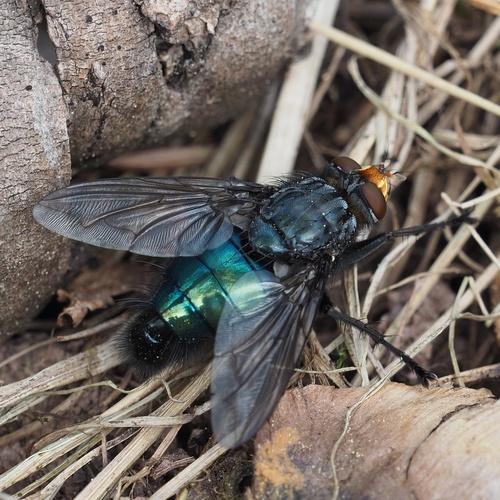
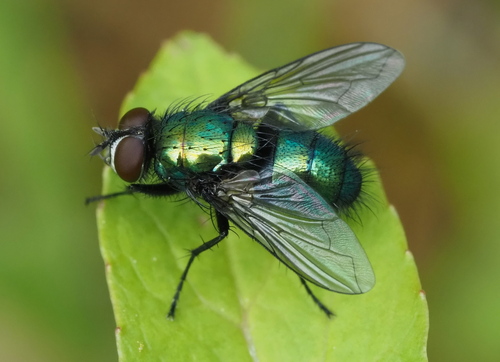
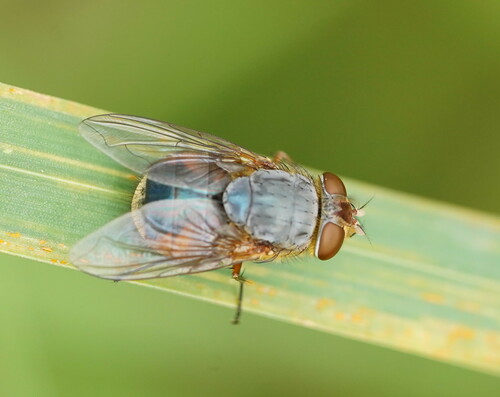
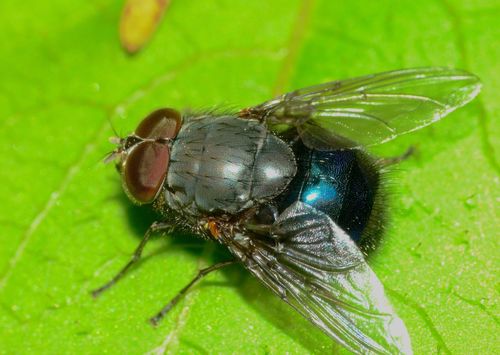
Mature morphology: The adult New Zealand blue blowfly is New Zealand's largest native blowfly, with a body length ranging from 9.5 to 15.0 mm. Adults have a head, thorax, abdomen, and one pair of wings. In males, the head is holoptic, meaning the eyes meet along the midline of the front of the head; in females, the head is dichoptic, meaning the two eyes are separated. The eyes are densely covered in hairs in both sexes. The thorax has very large orange spiracles, which are openings that function as the insect's respiratory system. The thorax is mostly black, except for the scutellum (the lower dorsal part of the thorax), which is brownish in colour. The mesonotum (the middle sclerotized plates on the dorsal thorax) has an even coating of grey dust. The bases of the wings are darkened with a brown tinge, and the wing veins are brown. The femoral segments of the legs are blackish brown with a thin coating of grey dust, while the tibiae are reddish brown. The abdomen is black with no dusting, and has a violet or blue-green iridescence.
Distribution: The New Zealand blue blowfly is endemic to New Zealand, meaning it is native only to New Zealand. It is found throughout mainland New Zealand, as well as on the outlying Chatham, Auckland, Stewart, and Campbell Islands. Specimens collected from Auckland and Campbell Islands differ slightly from mainland individuals: their abdomens have blue-green metallic colouration instead of the violet metallic colouration seen on mainland individuals.
Habitat preferences: This species occurs across all of New Zealand and can survive in most habitats, though it prefers mountainous areas where snow tussock grows, particularly in the mountain ranges of the South Island and on Stewart Island. This species is known to be involved in fly strike in sheep. It does not initiate fly strike itself, but acts as a secondary agent, so it can also be found in farmland areas. This species is very rarely found indoors.
Life cycle and phenology: C. quadrimaculata has a relatively short life cycle. Females deposit eggs in a growing medium; unlike many related species, this medium does not need to be a decaying carcass, and can be decaying leaf matter. Eggs hatch into larvae after 24 hours. Larval development has three growth stages, during which larvae feed on either plant or animal tissues. After eight days, larvae stop feeding, leave the feeding area, and move to develop into pupae. Pupation occurs either near the original feeding site, or within approximately 3 cm below the surface of dry soil. Before pupation, larvae empty their stomach contents and contract to form the pupal case. An adult fly that is ready to mate emerges approximately two weeks after pupation begins. Females have a pre-egg-laying period of 4 to 7 days, and live for approximately 2 to 3 weeks total. Over their lifespan, females deposit between 600 and 800 eggs. The entire life cycle from egg to mature adult that can produce new eggs is 20 to 25 days long. This species mates predominantly in the summer months, particularly February, as it requires warmer temperatures for development from egg to adult.