About Calliphara nobilis (Linnaeus, 1763)
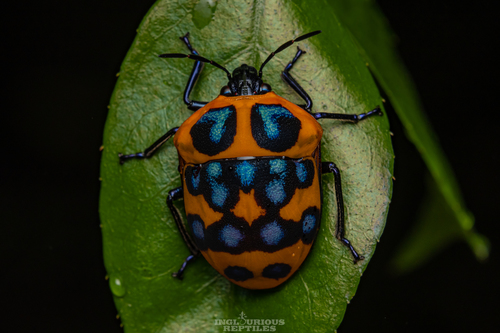
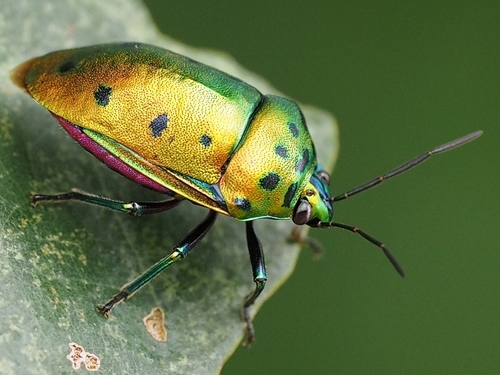
Calliphara nobilis is a species of jewel bug. Like all jewel bugs, it has brilliant metallic coloration and a greatly enlarged scutellum that forms a continuous shield covering its abdomen and wings. This enlarged scutellum distinguishes jewel bugs from most other heteropterans, and often causes people to misidentify them as beetles instead of true bugs. Its pronotum and scutellum are mostly metallic orange with greenish iridescence, and each structure bears seven black spots. Extreme color variation, ranging from orange to blue-green, has been observed within single populations of this species. The ostioles (openings of the external efferent system) of its metathoracic scent glands are large. The exocorium of its forewings is only minimally exposed near the base, and the distal tip of the hemelytral membrane is barely visible at the rear. Its head, tibiae, and tarsi are iridescent green, while its femora are mostly orange. It has four-segmented antennae that are dark in color, and it has large eyes. The ventral side of its abdominal sterna is dark, iridescent, and punctate along the sides, and lighter along the midline. The posterolateral corners of the sterna are smooth and do not have spines. Adult Calliphara nobilis are 10–15 millimeters (0.4–0.6 inches) long.
This species’ distribution is bounded by Myanmar on the west, the Philippines and Maluku Islands on the east, Taiwan in the north, and Australia’s Northern Territory in the south. It inhabits coastal vegetation, specifically tropical mangrove forests that grow in saline or brackish water. Known plant hosts for Calliphara nobilis include Acer oblongum, Casearia species, Excoecaria agallocha, Gossypium hirsutum, Macaranga tanarius, Phyllanthus species, Ricinus communis, Rhizophora species, Santalum album, and Xanthium strumarium.
Calliphara nobilis is a gregarious phytophagous species. Adults can be found in large numbers on the leaves of any of its host plants, but females only lay eggs on the leaves of Excoecaria agallocha — commonly called river poison tree, blind-your-eye mangrove, milky mangrove, or buta-buta tree — because its nymphs feed exclusively on the seeds of this plant. Since none of its host plants are of significant economic importance, C. nobilis is not considered a pest species. It should not be confused with Scutellera nobilis (also called Scutellera perplexa), a similar metallic shield bug that acts as a minor pest of grape, Jatropha curcas, and Phyllanthus emblica crops in India.