About Callipepla squamata (Vigors, 1830)
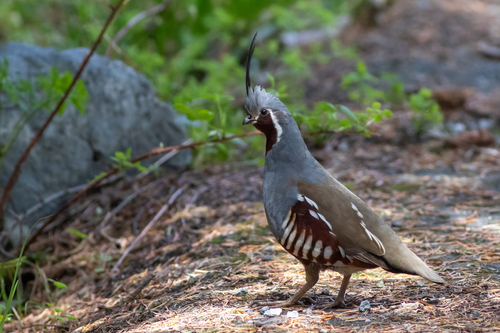
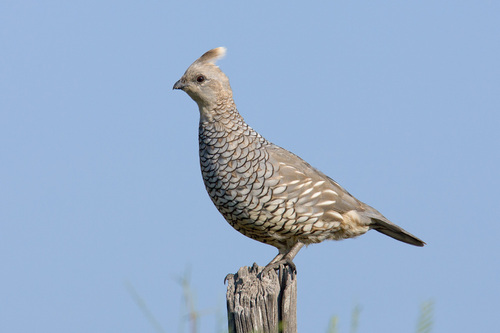
The scaled quail (Callipepla squamata), commonly known as blue quail or cottontop, is a species in the New World quail family. It is a bluish gray bird native to arid regions stretching from the Southwestern United States to Central Mexico. This species is an early offshoot of the genus Callipepla that diverged during the Pliocene. It gets its common name from the scaly pattern on its breast and back feathers, and it is also easily recognizable by its white cotton tuft-like crest. Its nest is typically a grass-lined hollow that holds 9 to 16 speckled eggs. When disturbed, scaled quail prefer to run rather than fly. Widespread and common across its range, the scaled quail is listed as Least Concern on the IUCN Red List of Threatened Species.
In terms of distribution and taxonomy, native scaled quail range from south-central Arizona, northern New Mexico, east-central Colorado, and southwestern Kansas, south through western Oklahoma, and western and central Texas into Mexico, reaching as far as northeastern Jalisco, Guanajuato, Queretaro, Hidalgo, and western Tamaulipas. It has been introduced to Cuba, Jamaica, Haiti, the Dominican Republic, Puerto Rico, Hawaii, central Washington, eastern Nevada, and Nebraska in the United States, but is only established in central Washington and eastern Nevada. Four subspecies of scaled quail are recognized: Callipepla squamata squamata (Altiplano scaled quail), the nominate subspecies found only on the Central Plateau (altiplano) of Mexico; Callipepla squamata pallida (northern scaled quail), the most common subspecies, ranging from Arizona and New Mexico to Colorado, just into Oklahoma, and western Texas, northern Chihuahua, and Sonora, and it is paler than the nominate subspecies; Callipepla squamata hargravei (Upper Sonoran scaled quail), an arid habitat form found only at the intersection of Colorado, Kansas and Oklahoma, and in northwestern New Mexico, it is the palest subspecies adapted to dry, sandy habitat; and Callipepla squamata castanogastris (chestnut-bellied scaled quail), found in southern Texas from Eagle Pass and San Antonio south to adjacent northwestern Mexico (Coahuila, Nuevo León, and Tamaulipas), this subspecies is distinguished from all others by its chestnut brown belly, and it is darker than the other two subspecies found in the United States. Similar individuals to this subspecies are sometimes found in the extreme northeast and west of the species' overall range.
Scaled quail prefer dry, open valleys, plains, foothills, rocky slopes, draws, gullies, and canyons that contain a mix of bare ground, low herbaceous growth, and scattered brushy cover. Good scaled quail habitat features low-growing grasses mixed with forbs and shrubs, with total ground cover between 10 and 50%, and trees and shrubs shorter than 6.6 feet (2.0 m). Scaled quail avoid dense streamside vegetation. Studies with transmitter-fitted scaled quail recorded individual home range sizes of 52 and 60 acres (21 and 24 ha). Researchers have not confirmed an absolute requirement for open water for scaled quail, and there is ongoing debate in scientific literature on this topic. Scaled quail have been recorded living 7 to 8 miles (11 to 13 kilometres) from the nearest water in Arizona; in New Mexico, it was not uncommon to find them 10 to 15 miles (16 to 24 kilometres) from water; Wallmo observed winter coveys 3 and 7 miles (4.8 and 11.3 kilometres) from water in Big Bend National Park, southwestern Texas; and in Arizona, scaled quail summer habitat is rarely within 660 feet (200 m) of water. However, scaled quail were observed drinking at stock tanks every 2 to 3 days between April and June, a dry period during the relevant study. In Oklahoma, scaled quail often move to farms and ranches in winter, so they are closer to water in winter than in summer; DeGraaf and colleagues reported that in winter, scaled quail are usually found within 1.25 miles (2.01 km) of a water source.
Scaled quail are opportunistic feeders. They eat seeds year-round, and large seeds such as those from mesquite and snakeweed are particularly important parts of their diet. Other consumed seeds come from elbowbush (Forestiera angustifolia), catclaw acacia, hackberry (Celtis spp.), Russian-thistle, rough pigweed (Amaranthus retroflexus), sunflowers, ragweeds (Ambrosia spp.), and other Asteraceous plants. Scaled quail consume more grass seeds than other quail species. Their diet also includes leaves, fruits, and insects. Summer diets are high in green vegetation and insects, which also act as important moisture sources. In Oklahoma, small groups of scaled quail feed among soapweed yucca, in soapweed yucca-sand sagebrush ranges, weed patches, and grain stubble. Early winter foods in Oklahoma, typically eaten when other foods are unavailable, include snow-on-the-mountain (Euphorbia marginata), sand paspalum (Paspalum stramineum), field sandbur (Cenchrus pauciflorus), purslane (Portulaca spp.), skunkbush sumac, Fendler spurge (Euphorbia fendleri), and leaf bugs. Jimsonweed (Datura stramonium) and juniper berries are always avoided by scaled quail in Oklahoma, and common winter foods there include Russian-thistle and sunflower (Helianthus spp.) seeds. In northwestern Texas, food selection by scaled quail depends on foraging techniques, food availability, and seed size. Small seeds are selected when they remain on the plant and can be easily stripped, but are not eaten after they fall, likely because they are too small and/or difficult to locate. Broom snakeweed (Gutierrezia sarothrae) is a staple winter food; it is not highly preferred, but is consumed in proportion to its availability when fewer preferred food items are available. Overall, grass seeds, mainly tall dropseed (Sporobolus asper) and rough tridens (Tridens muticus), are major components of scaled quail diets in Texas, a pattern linked to precipitation patterns that result in higher grass seed availability and lower forb availability in the region. In the same Texas study, green vegetation made up a larger proportion of the diet than recorded for other regions. In southwestern Texas, chestnut-bellied scaled quail eat woody plant seeds and green vegetation. Brush species seeds made up 68% of the stomach contents from 32 sampled scaled quail, while green food (chiefly wild carrot [Daucus carota] and clover [Trifolium spp.]) made up 7.17% of the contents. Elbowbush was the single most important food source, followed by Roemer acacia (Acacia roemeriana), desert-yaupon (Schaeferia cuneifolia), and spiny hackberry (Celtis pallida). In southeastern New Mexico, staples that make up at least 5% of the scaled quail diet in both summer and winter are mesquite and croton (Croton spp.) seeds, green vegetation, and snout beetles. Non-preferred foods eaten in winter, which were available but not consumed in summer, include broom snakeweed (the main winter food), crown-beard (Verbesina encelioides), cycloloma (Cycloloma atriplicifolium), and lace bugs. Combined, mesquite seeds and broom snakeweed seeds made up 75% of the winter diet. Grasshoppers are a summer staple. Insect galls, cicadas, scarab beetles, spurge (Euphorbia spp.), plains bristlegrass (Setaria macrostachya) seeds, and white ratany (Krameria grayi) are consumed with less pronounced seasonal patterns. Another study recorded substantial amounts of prairie sunflower (Helianthus petiolaris) seeds and pigweed (Amaranthus spp.) seeds in scaled quail diet. Scaled quail also feed in alfalfa (Medicago spp.) fields.