About Calliostoma supragranosum P.P.Carpenter, 1864
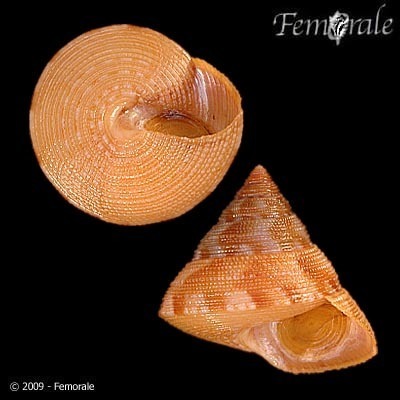
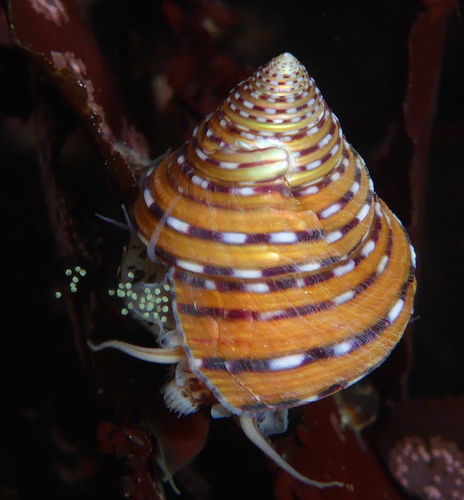
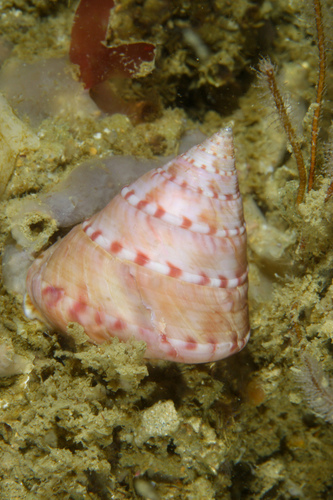
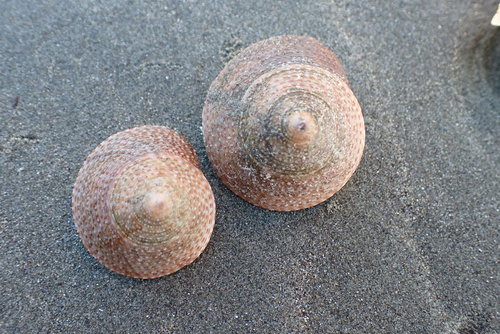
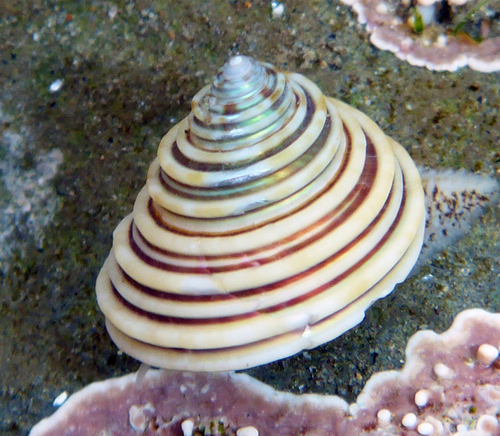
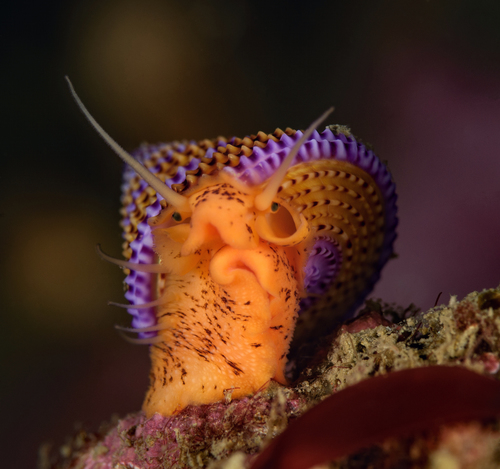
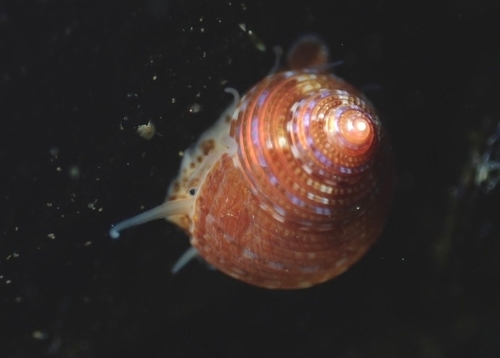
Calliostoma supragranosum P.P.Carpenter, 1864 is a small species of sea snail with a distinct shell morphology. The rather thin, conical shell of this species ranges in height from 6 mm to 15 mm, and is imperforate. The shell is formed of 5 convex whorls. Its shell sculpture is defined by numerous fine spiral cords; these cords are strongly beaded on the early whorls, and may become weakly beaded on later whorls. The apical whorl is very small, smooth, and whitish in color. The following 2 whorls are circled by 2 strong, articulated ribs. On the next whorl, these ribs become beaded, and smaller beaded riblets develop above the ribs. The body whorl has 4 (or occasionally 5) strong, elevated ribs around its middle, with two or three beaded ribs above these ribs. The base of the shell has 9 fine, distinct, smooth concentric lirae. The body whorl is somewhat biangular at its periphery, and slightly convex beneath. The oblique aperture is nearly round. The peristome is thin, and slightly crenulated inside. The columella has a slight excavation, and is very bluntly nodulous near its base. The interior of the shell is brightly nacreous. Shell color is typically light yellowish-brown, with irregular lighter subsutural maculations. Very rarely, the shell may have pink or purple beads, or more rarely still a pink or purple stripe. There is a peripheral circle of alternating chestnut and white spots on the shell, and the ribs on the base of the shell are minutely patterned with alternating chestnut and white segments. This species occurs in the ocean from Monterey Bay, California, United States, to Asuncion Island in southern Baja California, Mexico.