About Calliostoma ligatum (Gould, 1849)
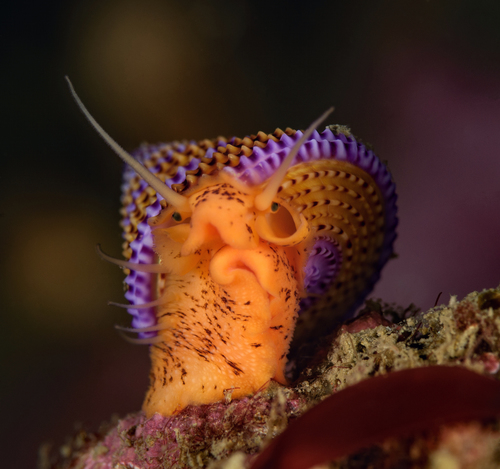
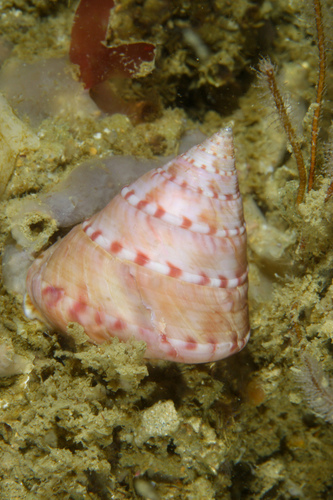
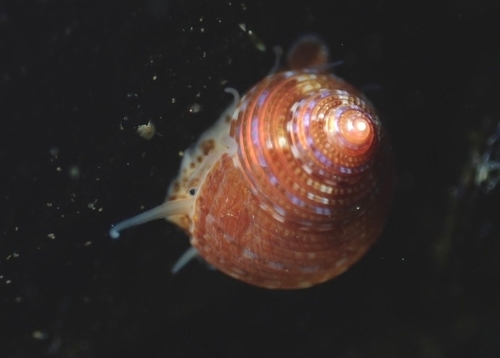
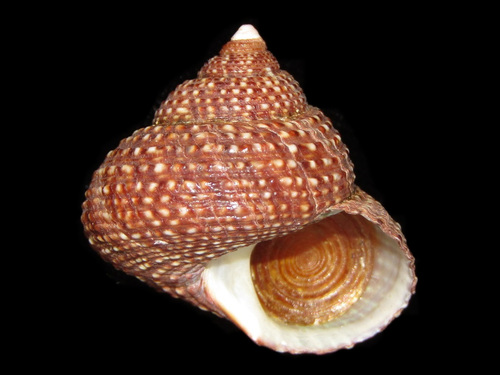
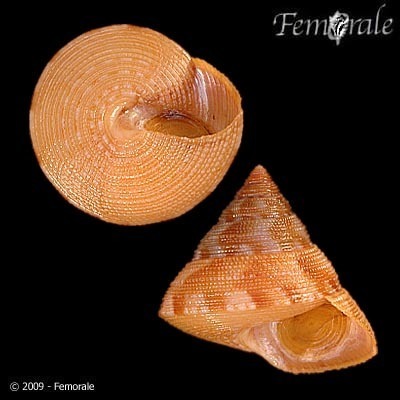
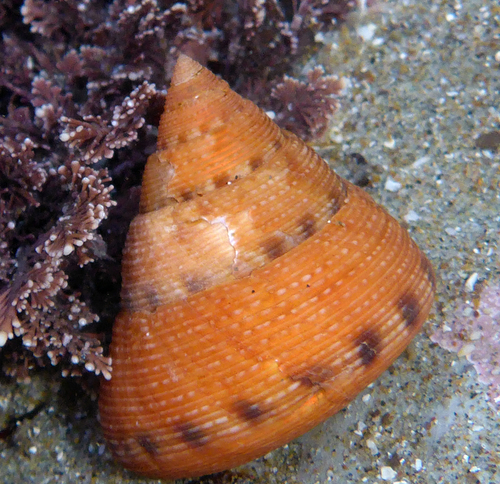
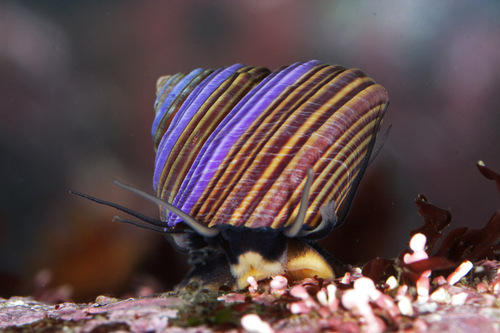
Calliostoma ligatum (Gould, 1849) has a conical, solid shell with well-rounded globose whorls, six to eight smooth spiral cords per whorl, and no umbilicus. The base of the shell is flattened. The entire surface is encircled by numerous smooth spiral riblets, and the gaps between these riblets are closely, finely marked with oblique striae. There are usually seven to nine riblets on the penultimate whorl, and around nine riblets on the shell's base. The spire is conical, the apex is acute, and the sutures are impressed. The shell has approximately seven convex whorls. The body whorl is rounded, or slightly angled, around its lower portion, and is slightly convex on its underside. The oblique aperture is rounded. The outer lip is grooved internally, with a beveled opaque white submarginal area. The throat of the shell is pearly and iridescent. The simple columella is curved. The base shell color ranges from chocolate brown to mauve, with light tan raised cords, and the aperture is pearly white. The apex is darker than the rest of the shell and usually purple. The shell is relatively heavy for its size, and its length and width are roughly equal; both measurements can reach up to 24 mm. This species is distributed from Alaska to San Diego, California. Calliostoma ligatum is a broadcast spawner. Snails held in laboratory conditions in the San Juan Islands, WA, USA, spawned during February, March, and April, but only when water temperatures were at least 10 °C. Females release eggs embedded in delicate strands of mucus that break down quickly after release. These strands are 1 to 3 mm wide, and contain 1 to 4 eggs across their width. Ten to ninety eggs are released in each spawning pulse, and multiple egg pulses are released during a single spawning event. Males release sperm as a milky white cloud, and fertilization takes place in open water. Unfertilized eggs are just over 200 micrometers in diameter, and an egg plus its protective gelatinous chorion measures about 750 micrometers in diameter. Early development follows spiral cleavage, the pattern typical of molluscs and other protostomes. Embryos cultured at 7 to 9 °C reach the trochophore larval stage in 3 days, complete torsion in 4.5 to 5 days, and hatch 6 days after fertilization. Veliger larvae stop swimming and begin crawling 9.5 days after fertilization, and undergo metamorphosis into juvenile snails approximately 12 days after fertilization. This snail is commonly found on rocks in the low intertidal zone, and in the shallow subtidal zone on large kelp, especially the giant kelp Macrocystis. Calliostoma ligatum eats a variety of food items, including the kelp it inhabits, as well as small sessile organisms and other organic material found on rock or kelp surfaces, including bryozoans, hydroids, diatoms, and detritus. This species exhibits a wide range of distinct behavioral reactions to contacts with other animals. Between 70% and 100% of tested individuals displayed a flight response, with movement speeds reaching up to 10 cm per minute often accompanied by shell twisting, after contact with four species of predatory sea stars: Leptasterias hexactis, Pycnopodia helianthoides, Pisaster ochraceus, and Evasterias troschelii. After contact with the subtidal crab Cancer oregonensis, snails either withdrew into their shells, turned away, or fled. C. ligatum showed only a weak response to contact with most predatory snails, but Fusitriton oregonensis elicited the strongest response among all tested predatory snails. Contact with F. oregonensis caused around half of tested snails to exhibit a flight response, while others bit the predator with their radula, simply turned away, or showed no response at all. C. ligatum frequently uses its radula to rasp, or bite, non-predatory animals. When contacting the non-predatory sea star Henricia leviuscula, C. ligatum bit the sea star in every observed interaction. After making initial contact, the snail reared up, extended its head forward, and visibly rasped the upper body wall of H. leviuscula with its radula, which caused the sea star to move away. C. ligatum similarly uses its radula to rasp, or bite, the sea stars Solaster stimpsoni in around 60% of contacts, and Dermasterias imbricata in around 40% of contacts. C. ligatum also routinely rasps, or bites, the snails Ceratostoma foliatum, Searlesia dira and Amphissa columbiana, which causes these snails to move away from C. ligatum.