About Calliostoma canaliculatum (Lightfoot), 1786
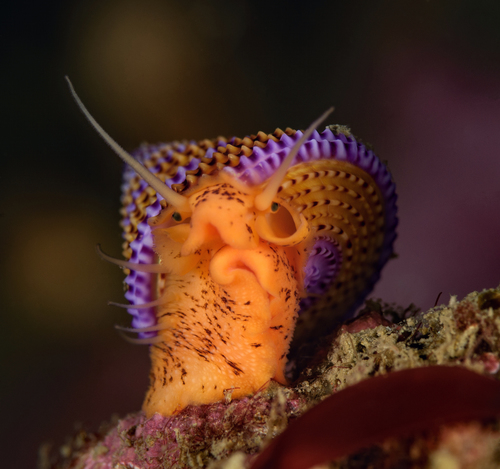
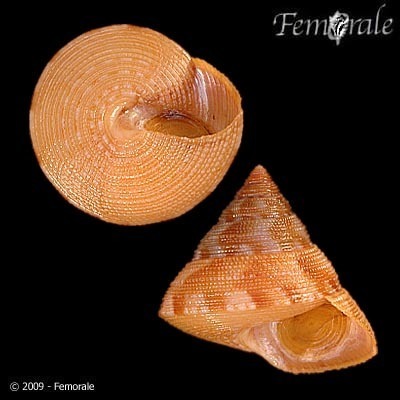
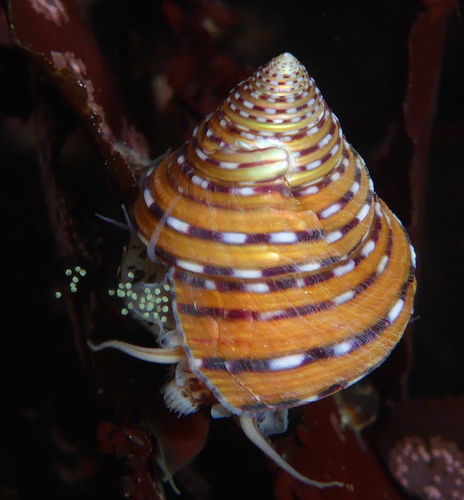
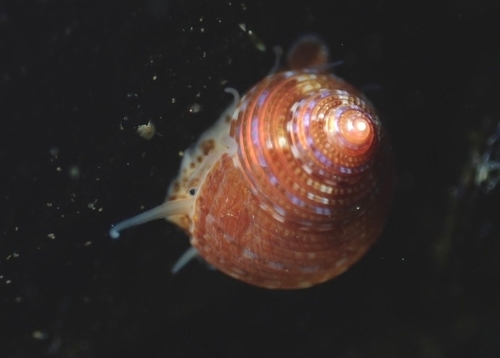
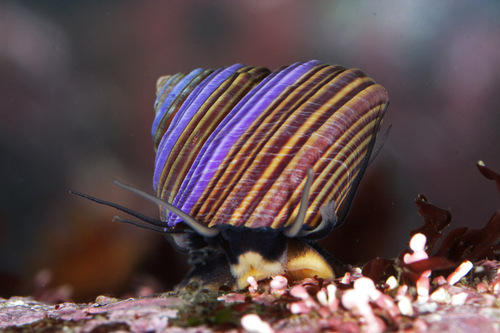
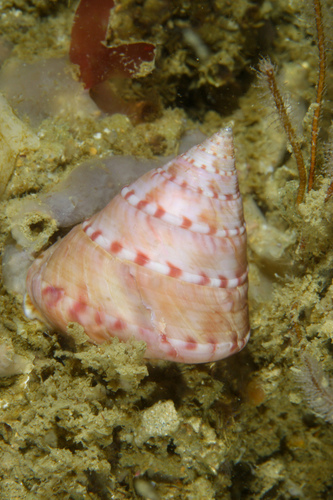
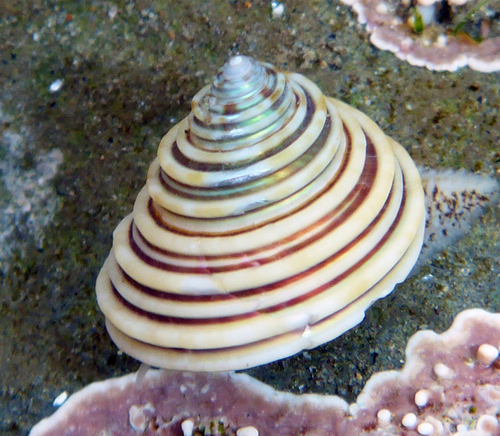
This species is a sea snail with the scientific name Calliostoma canaliculatum (Lightfoot), 1786. The shell size varies between 16 mm and 39 mm, and its height ranges from 15 mm to 35 mm. The thin, imperforate shell has a conical shape and a flat base. Its color ranges from white to buff or fawn, with yellowish-white raised spiral ribs (called lirae) and brownish spaces between the ribs. There is a small blue stain adjacent to the columella. The surface of the shell's whorls is encircled by numerous sharply sculptured, smooth, narrow, cord-like lirae, which are mostly equal in size or alternately smaller. The base of the shell has 11 to 13 similar lirae. Upper whorls have fewer lirae, and in well-preserved individuals, the second whorl is minutely beaded on its upper part. The spire is conical with nearly straight outlines, and the sutures between whorls are impressed. The spire holds 7 to 8 whorls; the last whorl is obtusely angular, flat on its underside, and impressed around the axis. The oblique aperture is rhombic, iridescent, and sulcated inside. The thin peristome is acute. The columella is straightened, not truncate at the bottom, and dilated into a pearly iridescent pad at the top, which is bounded by an opaque white deposit. The mucus of this species contains the toxin BrMT. This species is distributed from Sitka, Alaska, to Camalu, northern Baja California, Mexico. Its habitat is on kelp leaves in deep water, and on reefs off Santa Barbara, California.