About Calliophis nigrescens (Günther, 1862)
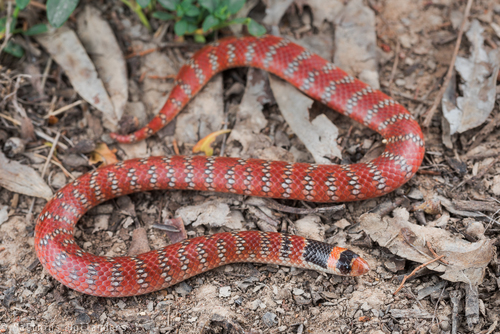
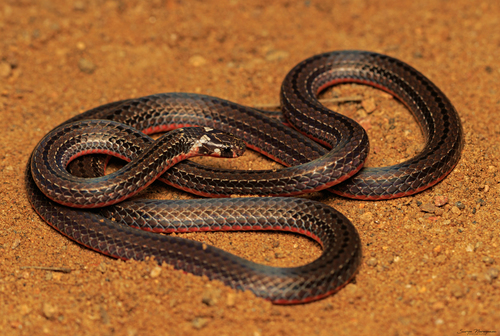
This species is scientifically named Calliophis nigrescens (Günther, 1862). For definitions of scale-related terms used in this description, see snake scales. The rostral scale is broader than it is long. The frontal scale is as long as its distance from the tip of the snout, and much shorter than the parietal scales. There is one preocular scale and two postocular scales, one temporal scale, and seven upper labial scales; the third and fourth upper labials extend into the eye socket. The anterior chin shields are as long as the posterior chin shields, or slightly shorter, and contact four labial scales. Dorsal scales are arranged in 13 rows. There are 232 to 261 ventrals; the anal scale is usually divided, and there are 33 to 44 subcaudals. This species includes multiple color varieties connected by unnoticeable gradations. Across all varieties, the head and nape are black, with an oblique yellow band (sometimes broken into spots) on each side running from the parietals to behind the corner of the mouth. The upper lip is yellow in areas both in front of and behind the eye, and the underparts are solid uniform red. Documented color variations are as follows: Variant A: Dark purplish brown on the upper body, with three or five longitudinal rows of black spots with light edges. Variant B: The spots are confluent, forming three longitudinal black bands bordered with whitish. Variant C: Intermediate between variant A and variant B. Variant D: Dark purplish brown on the upper body, with three or five more or less distinct black stripes that do not have light edges. Variant E: Pale reddish brown or red on the upper body, with five black stripes. Maximum recorded total length is 110 cm (43 in), with a tail length of 11.5 cm (4+1⁄2 in). Geographically, this species is found in India, specifically in the Western Ghats, within Karwar, Wayanad, Nilgiris, Anamalai, and the Travancore hills, at elevations between 4,000–6,000 feet (1,200–1,800 m).