About Callionymus pusillus Delaroche, 1809
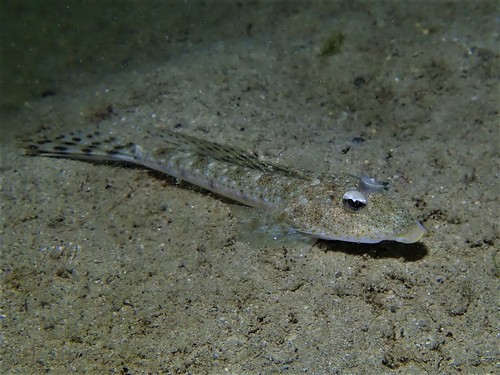
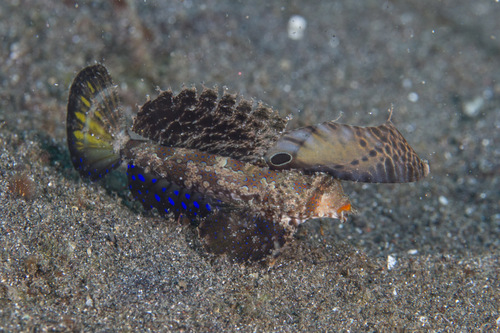
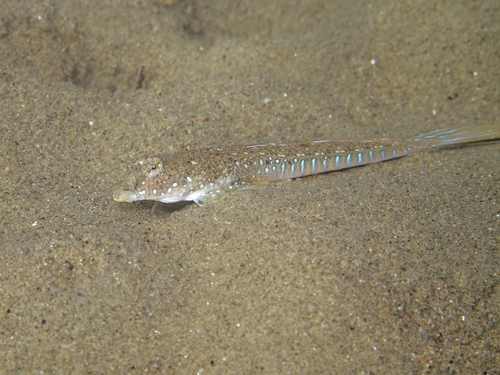
The sailfin dragonet, scientifically known as Callionymus pusillus, is a dragonet species commonly found in the Eastern Atlantic Ocean. Its Atlantic range extends along the Portuguese coast north to Lisbon, and south to Morocco. It is also found across the northern Mediterranean Sea, including the Adriatic Sea, Aegean Sea, and Black Sea, along the coasts of Lebanon and Israel, and along the southern Mediterranean shore as far east as Tunisia. Mature males of this species reach a total length of 14 centimetres (5.5 inches), while females grow to a maximum total length of 10 centimetres (3.9 inches). In the Mediterranean regions it inhabits, the sailfin dragonet is one of the most common dragonet species, and is the only dragonet species recorded in many local protected areas. It is a benthic species that lives in shallow waters, and prefers sandy seabeds down to a depth of 100 metres (330 feet). Males of this species are territorial, and aggressively defend their territories from other males. Like other dragonets, this species goes through complex four-phase breeding behaviour. The process begins with courtship; after courtship, a male and female pair up, then ascend to the water’s surface to release their eggs and milt. In the Mediterranean, the spawning season for this species runs from May to August. The eggs and larvae of the sailfin dragonet are pelagic. The species feeds mainly on small benthic invertebrates, including worms and small crustaceans. The sailfin dragonet has three upward-pointing spines on its preoperculum. It can be distinguished from other dragonet species by its first dorsal fin, which is lower than its second dorsal fin. The second dorsal fin has long rays that extend into long filaments, which stretch out past the caudal fin. Males are brightly coloured: their bodies bear 14 to 16 silvery transverse lines fringed with black, and their fins have blue streaks. Females are beige, marked with small whitish spots.