About Callinectes sapidus Rathbun, 1896
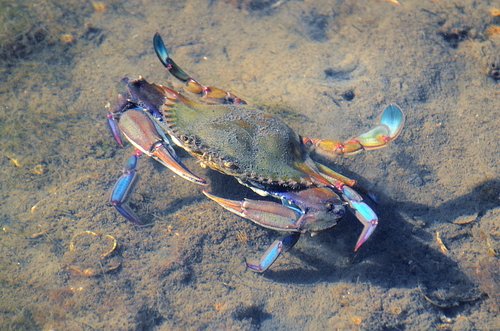
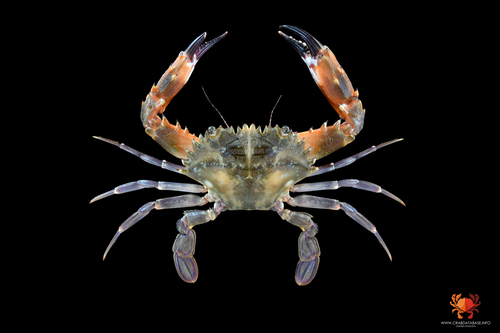
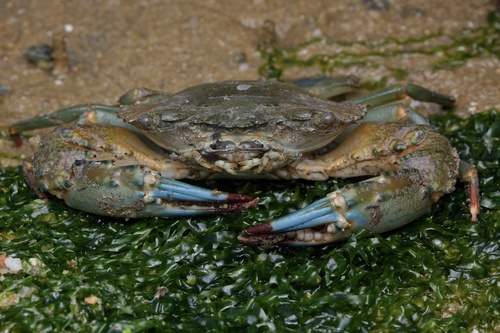
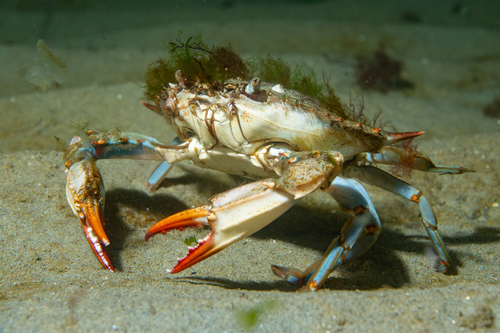
Callinectes sapidus, the blue crab, is a decapod crab in the swimming crab family Portunidae. The genus Callinectes can be told apart from other portunid crabs by the absence of an internal cartilaginous spine on the carpus (the middle claw segment), as well as the T-shape of the male abdomen. Blue crabs can reach a carapace width of 23 cm (9 in), and the species shows clear sexual dimorphism. Males and females are easily distinguished by the shape of their abdomen (called the "apron") and color differences in their chelipeds (claws). The male abdomen is long and slender, while the abdomen of mature females is wide and rounded; a common mnemonic compares the male's apron shape to the Washington Monument, and the mature female's to the dome of the United States Capitol. Claw color differences are more subtle than apron shape: the immovable fixed finger of male claws is blue with red tips, while female claws are orange with purple tips. A female's abdomen changes as it matures: immature females have a triangular abdomen, while mature females have a rounded abdomen. Other Callinectes species are easily confused with C. sapidus due to overlapping ranges and similar morphology. One such species is the lesser blue crab (C. similis), which lives further offshore than the common blue crab and has a smoother granulated carapace. Male lesser blue crabs also have mottled white coloration on their swimming legs, and females have violet-colored areas on the internal surfaces of their claws. C. sapidus can be distinguished from another related species that occurs within its range, C. ornatus, by the number of frontal teeth on the carapace: C. sapidus has four, while C. ornatus has six. The crab's characteristic blue color comes from multiple shell pigments, including alpha-crustacyanin, which interacts with the red pigment astaxanthin to produce a greenish-blue color. When the crab is cooked, alpha-crustacyanin breaks down, leaving only astaxanthin, which turns the crab bright orange-red. A 1975 study by Sheridan et al found that organochlorides accumulate in the hepatopancreas of C. sapidus, and that DDT is specifically converted to both DDE and DDD in this crab. C. sapidus is native to the western Atlantic Ocean, from Cape Cod to Argentina, and along the entire coast of the Gulf of Mexico. It has recently been recorded north of Cape Cod in the Gulf of Maine, which may represent a range expansion driven by climate change. It has been introduced to Japanese and European waters via ship ballast water, and has been observed in the Baltic, North, Mediterranean, and Black Seas. The first record of C. sapidus in European waters comes from 1901 at Rochefort, France. In some parts of its introduced range, C. sapidus is targeted by commercial crab fishing; this includes Greece, where the local population may be declining due to overfishing. In Italy, public awareness of the species' harmful impact on native molluscs is growing rapidly, and eradication efforts are currently underway in the Po delta area and along the Adriatic Sea coast, led by both local authorities and local fishermen. Commercial fisheries for C. sapidus operate along most of the Atlantic coast of the United States and in the Gulf of Mexico. While the fishery has historically been centered on Chesapeake Bay, catches from other regions are growing in importance. In the 21st century, most commercial blue crabs have been landed in four U.S. states: Maryland, Virginia, North Carolina, and Louisiana. Natural predators of C. sapidus include eels, drum, striped bass, spot, trout, some sharks, humans, cownose rays, and whiptail stingrays. C. sapidus is an omnivore, feeding on both plants and animals. Its typical prey includes thin-shelled bivalves such as clams, mussels, and oysters, plus crustaceans, annelids, small fish, and plants such as eelgrass. It will eat nearly any available food, including carrion, other C. sapidus individuals, and animal waste. In salt marshes, C. sapidus feeds on marsh periwinkles (Littoraria irrorata) during high tides. Though it is an aquatic predator, C. sapidus stays in shallow pits in salt marshes at low tide and ambushes intertidal prey such as fiddler crabs (for example Minuca pugnax) and purple marsh crabs (Sesarma reticulatum). C. sapidus may help control populations of the invasive green crab Carcinus maenas: population numbers of the two species are negatively correlated, and C. maenas is not found in Chesapeake Bay, where C. sapidus is most abundant. C. sapidus is host to a number of diseases and parasites, including multiple viruses, bacteria, microsporidians, ciliates, and other organisms. The nemertean worm Carcinonemertes carcinophila commonly parasitizes C. sapidus, especially females and older crabs, though it has little negative effect on the crab. A trematode that parasitizes C. sapidus is itself parasitized by the hyperparasite Urosporidium crescens. The most harmful parasites known for C. sapidus are the microsporidian Ameson michaelis, the amoeba Paramoeba perniciosa, and the dinoflagellate Hematodinium perezi, which causes "bitter crab disease". In 2021, University of Maryland scientists completed DNA sequencing of the C. sapidus genome in Baltimore after six years of research, to improve understanding of the species. This genetic map is expected to help scientists understand how blue crabs will be affected by climate change and warmer water temperatures, as well as identify which mutations cause disease, which traits influence meat production, and which females have the highest reproductive ability. Mating and spawning are separate events in blue crab reproduction. Males can mate multiple times and do not undergo major morphological changes during reproduction. Female blue crabs mate only once in their lifetime, during their pubertal (terminal) molt. During this transition, the female's abdomen changes from triangular to semicircular shape. Mating in blue crabs is a complex process that requires precise timing to occur when the female undergoes her terminal molt, and generally takes place during the warmest months of the year. Prepubertal females migrate to the upper reaches of estuaries, where adult males typically reside. Males actively search for receptive females and guard them for up to seven days until the female molts, when insemination occurs. Crabs compete with other individuals before, during, and after insemination, so mate guarding is critical for reproductive success. After mating, the male must continue guarding the female until her shell has hardened. Inseminated females can retain spermatophores for up to one year, and use these for multiple spawning events in high salinity water. During spawning, a female moves fertilized eggs onto her swimmerets and carries them in a large egg mass (called a sponge) while they develop. Females migrate to the estuary mouth to release larvae, and the timing of this release is thought to be influenced by light, tide, and lunar cycles. Blue crabs have high fecundity: females can produce up to 2 million eggs per brood. Migration and reproduction patterns differ between C. sapidus populations along the U.S. East Coast and in the Gulf of Mexico. A large-scale seasonal migration occurs in Chesapeake Bay, where C. sapidus may travel up to several hundred miles. In the middle and upper parts of the bay, mating peaks in mid- to late summer, while in the lower bay, mating activity peaks in spring and from late summer through early fall. Changes in salinity and temperature may affect the timing of mating, as both factors are important during the molting process. After mating, female crabs travel to the southern portion of Chesapeake Bay, using ebb tides to migrate from low salinity to high salinity areas, and fertilize their eggs with sperm stored from their single mating months or nearly a year earlier. Spawning events in the Gulf of Mexico are less distinct than in East Coast estuaries such as Chesapeake Bay. In the northern Gulf of Mexico, spawning occurs in spring, summer, and fall, and females generally spawn twice. During spawning, females migrate to high-salinity waters to develop an egg sponge, then return inland after their larvae hatch. They develop their second egg sponge inland, then migrate back to high-salinity waters to hatch the second brood. After this, females typically do not re-enter the estuary. Blue crabs along the southernmost coast of Texas may spawn year-round.