About Callimico goeldii (Thomas, 1904)
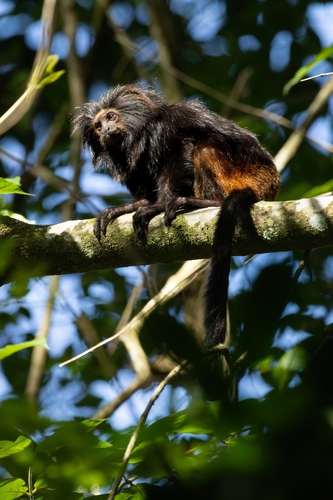
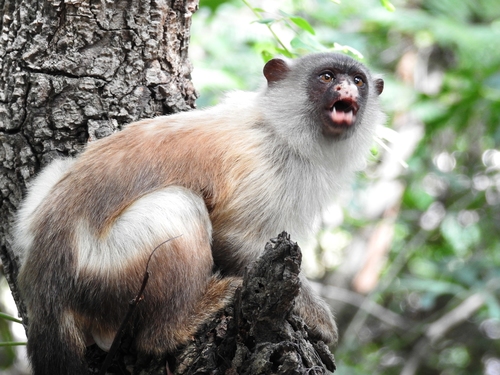
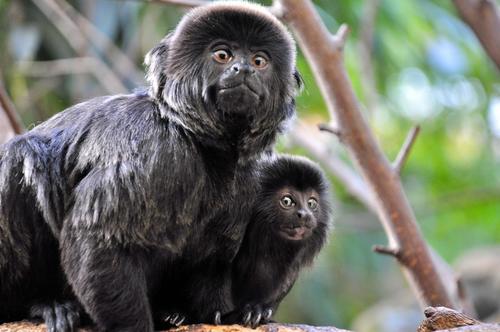
Goeldi's marmoset, also called Goeldi's monkey (Callimico goeldii), is a small New World monkey found in South America, primarily in the upper Amazon basin of Bolivia, Brazil, Colombia, and Perú. It is the only species in the monotypic genus Callimico, so the monkeys are sometimes called "callimicos". The species is named after its discoverer, Swiss-Brazilian naturalist Emil August Goeldi. Goeldi's marmosets are a dark-furred species, most often blackish-gray or darker brown; this is likely an evolutionary adaptation for camouflage to evade predators. The short fur on their heads gives them a superficial vague resemblance to the larger woolly monkey (Lagothrix), though the back of their necks, rumps, and tails often have light horizontal striping or highlights. Their bodies measure 8–9 inches (200–230 mm) in length, with tails adding an extra 10–12 inches (250–300 mm). Captive Goeldi's marmosets weigh around 480 g (17 oz), while wild individuals have been observed to weigh approximately 500 g (18 oz). All their digits have claw-like nails except for the hallux; these nails support clinging, scansorial (arboreal) movement and escape, and the extraction of tree-based food sources such as fruits, honey, and seed pods. The geographic range of callimicos runs from the Colombian Amazon and Río Caquetá (Japurá in Portuguese) to the Peruvian and western Brazilian Amazon, reaching into the Pando department of northwestern Bolivia, where high population densities have been reported. The species' presence in Ecuador has not yet been officially confirmed. The species has a patchy distribution, and its population density appears to depend on polyspecific associations with tamarins. Sightings of Goeldi's marmosets have been recorded at the base of the Cordillera Oriental of the Andes in Colombia, in the Department of Putumayo, along the Putumayo and Caquetá Rivers. In northern interior Perú, they live in Pucacuro National Reserve, near Río Tigre, where local people call them chi-chi. Further south, they have been found at the Centro de Investigación y Capacitación Río Los Amigos (Los Amigos River Training and Research Center, CICRA), Manu National Park, the Concesión de Conservación Rodal Semillero Tahuamanu (CCRST), and adjacent surrounding areas. They have also been spotted near the Yura River and Sierra del Divisor National Park in groups of 3 to 12 individuals. Starting in the 1970s through the early 2010s, observations of this species were collected via live-trapping. On one occasion, captured marmosets were taken for closer examination and breeding at the Centro de Conservación y Reprodución de Primates in Iquitos. Researchers also used food baits at stationary sites, along with recordings of the vocalizations of Goeldi's marmosets and their associated tamarins, to attract the monkeys. In Brazil, Goeldi's marmosets live in the southwest Amazon, in the west-central state of Acre across the Serra do Divisor, south near the Juruá River and into Gregório, Amazonas. They are also found near the Laco River, further south to the upper Purús, in the Madeira basin, and near the Abunã River in Rondônia. High densities of the species have been recorded in Bolivia's Pando department. Goeldi's marmosets prefer to forage in dense, scrubby undergrowth. This preference likely contributes to their rarity, as groups live in separate patches of suitable habitat, separated by miles of unfavorable habitat. In the wet season, their diet includes fruits, flowers, flying insects, spiders, mollusks, small lizards, tree frogs, and small or young snakes. In the dry season, they feed on fungi; they are the only tropical primates known to rely on fungi as a food source this way. They live in small social groups of around six individuals, which stay within a few feet of one another most of the time and maintain contact via high-pitched calls. They are also known to form polyspecific (interspecific) groups with tamarins, including the white-lipped tamarin and brown-mantled tamarin. One proposed explanation for this association is that Goeldi's marmosets do not carry the X-linked polymorphism that allows some individuals of other New World monkey species to see full trichromatic vision. Females reach sexual maturity at 8.5 months, while males reach sexual maturity at 16.5 months. The gestation period lasts 144 to 159 days. Studies of callimicos held in captivity in North America and Europe over nearly 40 years found that they produce an average of 3.5 offspring over their lifetime. However, 30% of females and 45% of males observed in captivity never reproduced. Unlike other New World monkeys, Goeldi's marmosets can give birth twice per year. Biannual births happen regularly in captivity and less consistently in the wild. This ability comes from postpartum estrus, which allows females to become ready to reproduce soon after giving birth. The year-round availability of fungus, an important food source for C. goeldii, also supports these multiple births. A female Goeldi's marmoset carries only a single baby per pregnancy, while most other species in the family Callitrichidae usually give birth to twins. Singleton births allow for longer maternal care and delayed weaning, which leads to faster offspring growth and, in turn, earlier sexual maturity than seen in other marmosets.