About Calliergon cordifolium (Hedw.) Kindb.
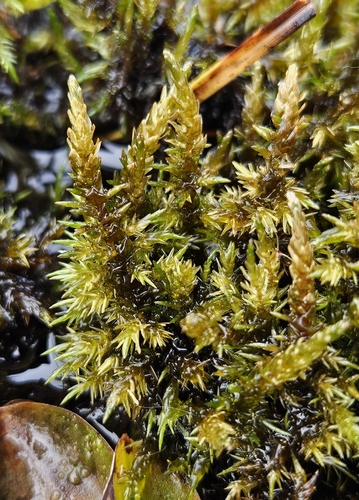
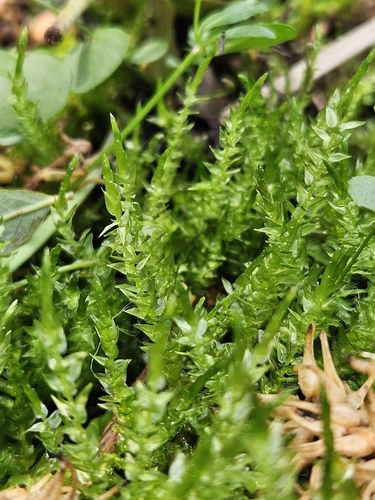
Calliergon cordifolium, with the full scientific name Calliergon cordifolium (Hedw.) Kindb., is a moss species belonging to the Calliergonaceae family. It is commonly called calliergon moss, though this name more generally refers to the entire Calliergon genus, or heart-leaved spearmoss. This species is abundant when growing in its suitable habitat. It grows in marshes and wet woodland, especially alder (Alnus) or willow (Salix) woodland, as well as along the edges of streams, ditches and pools. It grows in tufts alongside other moss species. Calliergon cordifolium requires a wet environment to grow, and often grows fully submerged in water. It typically favors lowland areas, but has been recorded growing as high as 910 metres (1,000 yd) above sea level in Inverness, Scotland. This species has a circumpolar Boreo-temperate distribution. It can be found across all of Europe, including as far north as the Arctic Circle, where it occurs on Svalbard, the Faeroe Islands, Iceland and Greenland, and extending east to the Caucasus. It has also been recorded in northern and central Asia, Turkey, Japan, all of North America, and New Zealand. Calliergon cordifolium is a medium-sized to large moss with erect green shoots. Shoots can grow up to 15 centimetres (5.9 in) long. Its leaves are egg-shaped, 2 to 2.5 millimetres (0.079 to 0.098 in) wide, extending outwards away from the stem. The base of each leaf is heart-shaped, while the leaf tip is rounded. Its spore-bearing capsules are rarely seen, and are only produced in spring or summer. Its spores measure 10 to 16 micrometres across. Calliergon cordifolium can be confused with several similar moss species: Calliergon giganteum, Calliergonella cuspidata, Straminergon stramineum and Pseudocalliergon trifarium.