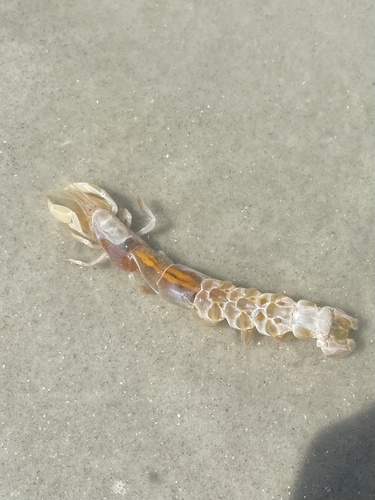
About Callichirus major (Say, 1818)
All species within the Callichirus major species complex share such strong morphological similarities that distinguishing between closely related members of the complex is difficult. C. major has a carapace with a rigid anterior margin; this margin extends backwards to the linea thalassinica — an uncalcified membranous groove that, in this species complex, is clearly parallel to the body’s longitudinal axis — and extends forwards to the rounded angles of the branchiostegal lung. The sternum is not easily visible between the first and third pairs of pereopods. The rostrum of the complex is flanked, with characteristic obtuse angles near the base of the eyestalks. The eyestalks almost reach the basal segment of the antennules’ peduncles. The third segment of the antennules is 1.5 to 2.5 times as long as the first and second segments combined. The coxae and bases of the maxilla are clearly separated. The first pair of pereopods is very unequal in size, especially in adult males, representing an unusually prominent example of sexual dimorphism within the genus. The second pair of pereopods has fully formed chelae, while the fourth and fifth pairs have relatively underdeveloped chelae. The first and second segments of the abdomen are membranous and soft; the second segment is longer than the first, and almost twice as long as the third, fourth, and sixth segments. The third, fourth, and sixth segments are roughly the same length, while the fifth segment is slightly longer than the segments adjacent to it. Unlike other species in its genus, C. major is gonochoristic. Vestigial traces of ancestral hermaphroditism — specifically, production of unused ovaries in males and extra gonopores in females — have been observed in C. macrotelsonis, and sister species such as C. seilacheri are fully functional hermaphrodites. This pattern indicates that the genus Callichirus may have a unique case of basal hermaphroditism in crustaceans that is not universal across all genus members. C. major sensu lato inhabits open, dissipative, flat sandy beaches, where it mostly lives in deep burrows in the intertidal zone, and can also be found in shallow subtidal depths of 2–3 m. It has a very large geographic range spanning Pan-American coastlines. On the Atlantic coast, it occurs from North Carolina to Santa Catarina, with a large distribution gap between Southern Texas and Pará; the species is only found sporadically in Colombia and Venezuela within this gap. On the Pacific coast, the complex has been recorded in both Baja California and Costa Rica. C. major sensu lato is widely used as live fishing bait by many coastal human communities, including those in the United States and Brazil, because it is easily accessible. Mass harvesting of ghost shrimp, including targeted harvesting of C. major, has been reported to be ecologically harmful: it damages the ecological stability of local ghost shrimp populations, and also kills other animals during the harvesting process. It has been suggested that this species complex qualifies as critically endangered on the IUCN Red List, but this assessment has not been officially reviewed by the IUCN.

