About Calliactis parasitica (Couch, 1842)
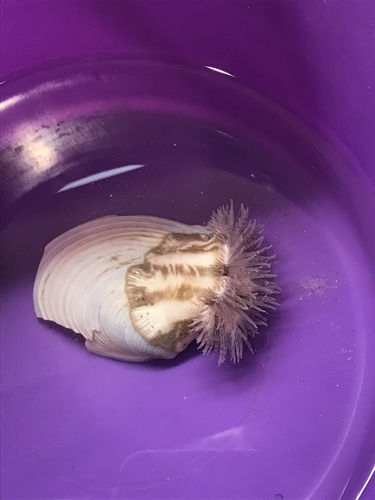
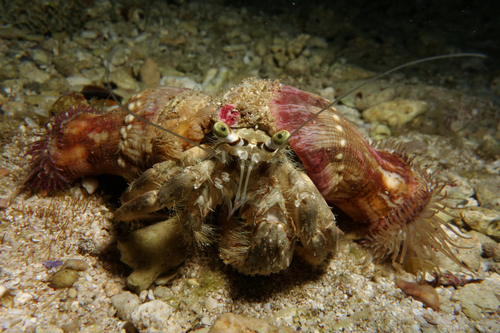
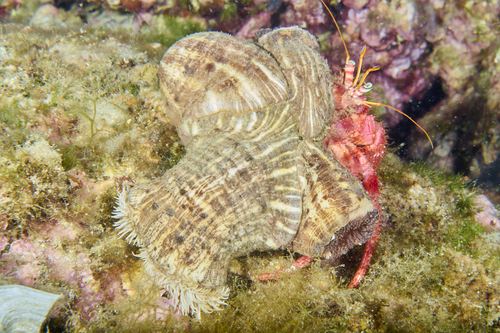
Calliactis parasitica can grow up to 100 millimetres (3.9 in) tall and 80 mm (3.1 in) wide, with a slightly wider base on its column. The column surface has a rough, leathery, grainy texture, lacks tubercles, and is not split into distinct sections. Its colouration is variable, but individuals are most often cream or buff, with reddish or greyish brown blotches and streaks that typically form vertical stripes. The basal disc is concave and can adhere firmly to substrates. Just above the limbus, the structure that connects the basal disc and the column, are relatively noticeable cinclides (specialized pores), each sitting on a small mound. When the anemone is disturbed, these pores readily release threadlike, stinging acontia. At the top of the column, there can be up to 700 slender, moderate-length tentacles. These tentacles are translucent, range in colour from yellowish to orange, and have longitudinal lines of reddish brown. Calliactis parasitica is native to the north-eastern Atlantic Ocean and the Mediterranean Sea. In the Atlantic, its range stretches from south-western Europe north to the west coasts of Wales and Ireland, and into the English Channel. While there are recorded occurrences of this species in the southern North Sea, these records are regarded as unconfirmed. It occurs from depths of 60 metres (200 ft) up into the sublittoral zone, and is very rarely found in the littoral zone. Although Calliactis parasitica will sometimes attach to stones or empty shells, it most commonly lives on a gastropod shell that is occupied by a hermit crab, and multiple individual anemones can share the same shell. In the British Isles, the associated hermit crab is most often Pagurus bernhardus, though other hermit crab species may partner with C. parasitica in other parts of its range. C. parasitica is thought to use chemical signals to detect its preferred shell type, that of the common whelk Buccinum undatum; it has been observed moving onto shells of living B. undatum in aquaria, though the whelk does not allow the anemone to stay attached. Both C. parasitica and its associated hermit crab can survive independently of one another, but their association benefits both partners, a relationship type known as mutualism. The hermit crab receives protection from predators from the anemone's stinging cells, while the anemone gets more access to food from particles stirred up by the hermit crab's movement. The association is initiated by the sea anemone, which carries out a complex sequence of movements to climb onto the hermit crab's carried shell, while the hermit crab stays passive during this process. Octopuses avoid shells that host C. parasitica, but will continue to attack shells occupied by the hermit crab Pagurus prideaux that host the sea anemone Adamsia palliata. In aquarium environments, the mutualism between C. parasitica and the hermit crab Dardanus arrosor can break down; the presence of octopus chemical signals prevents or reverses this breakdown. This suggests that the presence of cephalopods may be required to maintain the relationship between this anemone and its hermit crab partners.