About Caligo eurilochus (Cramer, 1776)
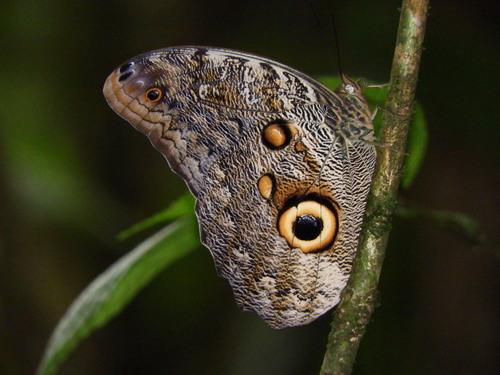
Caligo eurilochus, commonly known as the forest giant owl, is an owl butterfly that belongs to the tribe Brassolini of the nymphalid subfamily Morphinae. Its distribution ranges from Mexico, through Central America, to the Amazon River basin in South America, and its type locality is Suriname. This is a very large butterfly, ranked among the largest in its family, with a wingspan that can reach up to 17 centimetres. Several subspecies are currently recognized, though many additional subspecies have been proposed. The larvae of this species feed on a number of host plants. These host plants include Calathea latifolia from the family Marantaceae, Heychium sp. from the family Zingiberaceae, Heliconia latispatha from the family Heliconiaceae, and Musa spp. from the family Musaceae. Larvae also feed on the fruit of most Musa species. Females lay a large number of eggs on one of these host plants. Small larvae hatch approximately 3 to 5 days after eggs are laid. Fertile eggs develop a grey ring just above their center, while infertile eggs collapse. First instar larvae are white, with two orange/brown stripes running the full length of their body, and these stripes end in two small spindles at the posterior of the body. As larvae mature, they develop hairs that mimic spines, and grow a crown of four horns at the back of the head. When fully developed, larvae seek out a sufficiently high location to pupate and undergo metamorphosis. After metamorphosis is complete, the large adult owl butterfly emerges, pumps up its wings, and then goes in search of food. Adult butterflies drink the juices of fermenting fruits, as well as nectar from a wide variety of nectar plants.