About Caligavis chrysops (Latham, 1801)
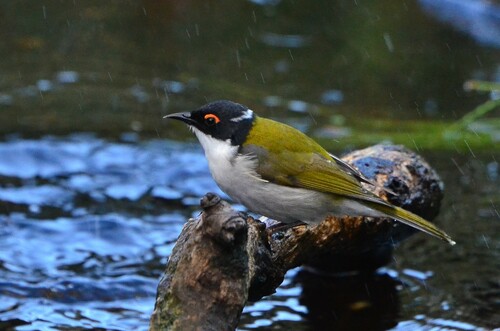
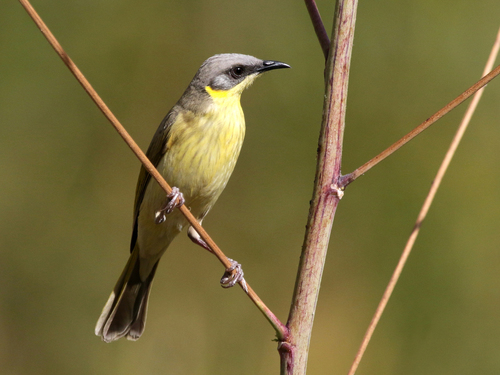
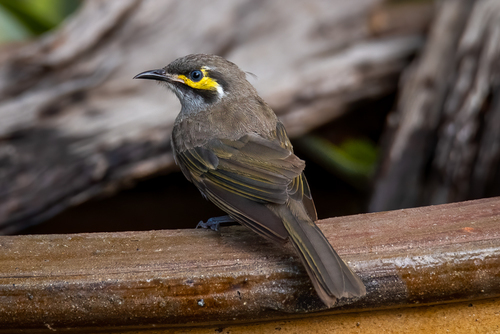
The yellow-faced honeyeater, with the scientific name Caligavis chrysops, is a small to medium-sized bird that belongs to the honeyeater family Meliphagidae. Both its common name and scientific name come from the characteristic yellow stripes running along the sides of its head. Its loud, clear call can often be heard starting twenty to thirty minutes before dawn. It is widespread across eastern and southeastern Australia, where it lives in open sclerophyll forests ranging from coastal dunes to high-altitude subalpine areas, as well as in woodlands along creeks and rivers. Compared to other honeyeaters, it has a comparatively short bill, which is thought to be an adaptation to its diet that includes flies, spiders, and beetles, plus nectar and pollen from plants such as Banksia and Grevillea, along with soft fruits. It catches insects both mid-flight and by gleaning them from the foliage of trees and shrubs. Some yellow-faced honeyeaters stay in one place year-round, but hundreds of thousands migrate northwards between March and May to spend the winter in southern Queensland, and return to southern New South Wales and Victoria in July and August to breed. They form socially monogamous pairs and build a delicate cup-shaped nest where they lay two or three eggs. Nest success rates can be low, so pairs will nest multiple times over a single breeding season. The preferred woodland habitat of this honeyeater is vulnerable to damage from land-clearing, grazing, and invasive weeds. Despite this habitat threat, the yellow-faced honeyeater is common and widespread, so the International Union for Conservation of Nature (IUCN) lists it as a species of least concern for conservation. In some areas, it is considered a pest in commercial orchards. Across its entire range, the yellow-faced honeyeater occupies a variety of habitats. It is most commonly found in open forests dominated by spotted gum (Corymbia maculata), alongside ironbarks and stringybarks such as narrow-leaved ironbark (Eucalyptus crebra) and silver-leaved ironbark (Eucalyptus melanophloia), with a light, shrubby understorey. It is less often found in dry open forests and woodlands dominated by Angophora, Acacia, Banksia, Casuarina or Callitris, or in high-altitude tall open forests of alpine ash (Eucalyptus delegatensis) and woodlands dominated by snow gum (Eucalyptus pauciflora) or white box (Eucalyptus albens). It has been recorded in coastal heath when banksias are blooming, and also among flowering mangroves. It will occupy areas infested with weeds, including Scotch broom (Cytisus scoparius) and blackberries, and also lives in developed areas such as orchards, parks and gardens, where it feeds on cultivated fruit and flowers. It can be found in forests that are regenerating after fire or logging, though it is more abundant in mature forests. In woodland areas, it is usually found in woodland located near forest, or woodland with an understorey of sclerophyll plants. The yellow-faced honeyeater's range forms a broad arc that generally follows the Australian coastline, starting from near Cooktown in Far North Queensland. Its range falls between a line running from Charters Towers south to Albury and the coast, and extends west to the Fleurieu Peninsula and the Mount Lofty Ranges in South Australia. Recorded population densities range from 0.01 birds per hectare (2.5 acres) near Armidale in New South Wales to 7.8 birds per hectare at Tarnagulla, Victoria. During the winter months of June and July, populations are generally lower in Victoria and higher in Queensland, matching the species' pattern of northward migration.