About Calidris virgata (J.F.Gmelin, 1789)
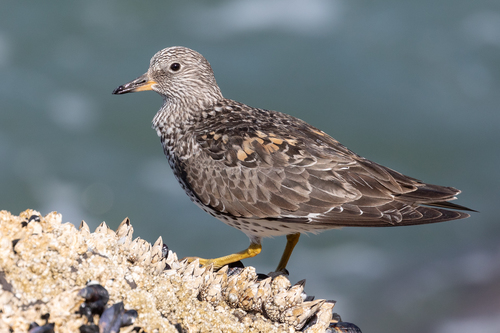
The surfbird (Calidris virgata) is a large sandpiper that resembles turnstones or the great knot. It measures 23 to 26 cm (9.1–10.2 in) long and weighs 133–251 g (4.7–8.9 oz). The sexes have similar appearance, but females are slightly larger than males on average. Surfbirds have breeding plumage from March through August: their heads, necks, breasts, and bellies are white with black streaking, while their crowns are rust-colored. Streaking becomes less prominent on the lower parts of the body.
For distribution and habitat, the surfbird has the longest and narrowest non-breeding distribution of any North American bird, ranging from Kodiak Island in Alaska to the Straits of Magellan at the southern tip of South America. Along this entire range, the species is rarely found more than a few meters from the shore. During the breeding season, it inhabits mountains of Alaska and western Yukon, at elevations between 150–1,800 m (490–5,910 ft). Surfbirds begin leaving their breeding grounds in July, with the last individuals departing in October, and start arriving at their main wintering grounds in Chile and Peru by mid-August. On return migration, they begin leaving South America in early March. Some individuals stay on the wintering grounds year-round. Vagrant surfbirds have been recorded in the Falkland Islands, Florida, and Texas. Migration routes are almost entirely coastal, with only a very small number of individuals seen inland during migration.
The species' breeding habitat is alpine tundra, with a preference for rocky ridges dominated by scree, rock fields, lichens, dwarf shrubs, and Dryas (mountain avens). It less commonly occurs in tundra with mosses and sedges, and is generally found away from suitable habitat that lies close to forest. In the non-breeding season, it is a rocky shore specialist, foraging on rocky shores, reefs, and coastal ledges. It feeds from the spray zone at the water's edge to just above the tide line, and in some cases will feed on sandy beaches and mudflats near rocky areas.