About Calidris subruficollis (Vieillot, 1819)
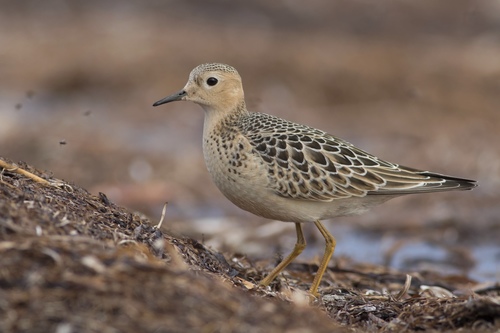
This species is brown on its upperparts, and has a buff-colored face and underparts across all plumage types. It has a short bill and yellow legs, with males growing larger than females. Juveniles have a similar appearance to adults, but may be paler on the rear of their underparts. C. subruficollis breeds in open arctic tundra in North America, and is a very long-distance migrant. It spends the non-breeding season primarily in South America, especially at Samborombón Bay in Argentina. Most individuals migrate through central North America, and the species is uncommon on the coasts. It is a regular wanderer to Western Europe, and is not classified as rare in Great Britain or Ireland, where small flocks have been recorded. Among American shorebird species that visit Europe, only the pectoral sandpiper is more common than this species. This species nests on the ground as far north as Canada, including Alaska, and lays four eggs per clutch. The male performs a display that involves raising its wings to show off their white undersides; this display is also given during migration, sometimes when no other buff-breasted sandpipers are present. Outside of the breeding season, this bird typically inhabits short-grass areas such as airfields or golf courses, rather than areas near water. These birds find food by sight, and feed mainly on insects and other invertebrates. Buff-breasted sandpipers are known to prey on Bombus polaris, a bumblebee species that lives within the Arctic Circle; they either eat the bees themselves or feed them to their young. They are often very tame. Buff-breasted sandpipers are suspected to have hybridized with the white-rumped sandpiper or Baird's sandpiper.