About Calidris subminuta (Middendorff, 1853)
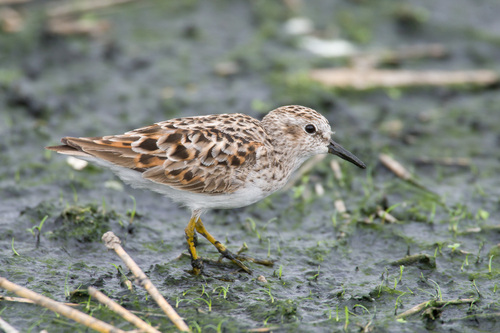
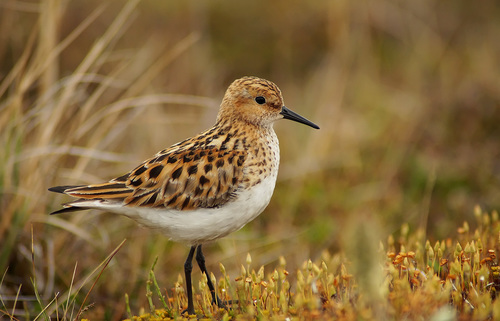
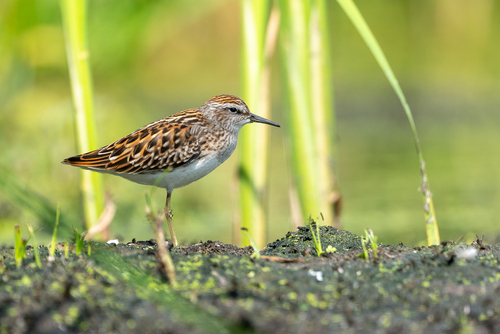
The long-toed stint (Calidris subminuta) is a very small wader. It measures 13 to 16 cm (5.1 to 6.3 in) in length, has a wingspan of 26.5 to 30.5 cm (10.4 to 12.0 in), and weighs approximately 25 g (0.9 oz). It has a small head, a short, straight, sharp-tipped beak, a slender neck, a rounded belly, and long legs set well back. Its toes are long and slender, particularly the middle toe. The primary feathers extend all the way to the tail. The crown is brown, with a pale streak just above the eye. The upper parts are brown, with darker brown feather centers. The breast is speckled with pale brown, and the underparts are white. The legs and feet are yellow, and the beak is dark brown except for the base of the lower mandible, which is yellow or pale brown. This species has a distinctive stance, and its flight call sets it apart from other sandpipers. When on the ground, it can be confused with the red-necked stint (Calidris ruficollis), but the long-toed stint is more finely built and slightly smaller. The long-toed stint breeds in Siberia during the Northern Hemisphere summer. Little is known about its breeding habits, but its breeding range includes the Chukchi Peninsula, the Koryak Plateau, the Commander Islands, the Kuril Islands, land bordering the Sea of Okhotsk, northern Verkhoyansky District, and the areas around the Ob River and the Irtysh River. After breeding, it migrates southward, passing through China, Indochina, Malaysia, and the Philippines, and westward to Burma, Bangladesh, Nepal, Sri Lanka, and the Maldive Islands. It is a Northern Hemisphere winter visitor to New Guinea and Australia, and a vagrant to Great Britain, Sweden, South Africa, Melanesia, Hawaii, the northwestern United States, and the vicinity of the Bering Sea. In its overwintering range, it uses a variety of wetland habitats, including shallow freshwater or brackish areas, lakes, swamps, floodplains, marshes, lagoons, muddy shores, and sewage ponds.