About Calidris pugnax (Linnaeus, 1758)
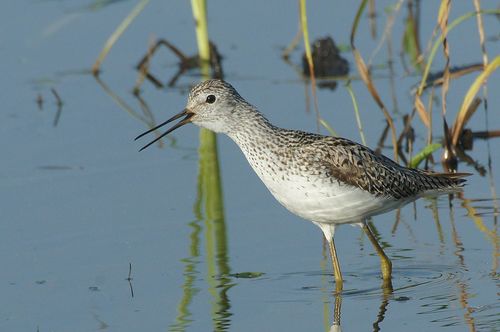
Description: The ruff (Calidris pugnax) has a distinctive pot-bellied appearance, with a small head, medium-length bill, longish neck, and heavy body. It has long legs that vary in colour: dark greenish in juveniles, pink to orange in adults, with some males having reddish orange legs only during the breeding season. In flight, it has a deeper, slower wing stroke than other similar-sized waders, shows a thin, indistinct white bar on the wing, and white ovals on the sides of the tail. This species exhibits strong sexual dimorphism. Though a small percentage of males resemble females, typical males are much larger than females and have elaborate breeding plumage. Males are 29–32 cm (11–13 in) long with a 54–60 cm (21–24 in) wingspan, and weigh 130–254 g (4.6–9.0 oz), making the ruff the largest species in the genus Calidris. During the May to June breeding season, a male’s legs, bill, and warty bare facial skin are orange, and he has distinctive head tufts and a neck ruff. These ornaments vary between individual birds, being black, chestnut, or white, with colouring that can be solid, barred, or irregular. The grey-brown back has a scale-like pattern, often with black or chestnut feathers, and the underparts are white with extensive black on the breast. The extreme variability of main breeding plumage is thought to aid individual recognition, since this species has communal breeding displays and is usually mute. Outside the breeding season, males lose their head and neck decorations and bare facial skin, and their legs and bill become duller. The upperparts are grey-brown, and the underparts are white with grey mottling on the breast and flanks. Females, called reeves, are 22–26 cm (8.7–10.2 in) long with a 46–49 cm (18–19 in) wingspan, and weigh 70–170 g (2.5–6.0 oz). In breeding plumage, females have grey-brown upperparts with dark-centred, white-fringed feathers. The breast and flanks are variably blotched with black. In winter, a female’s plumage is similar to a male’s non-breeding plumage, but the sexes can still be distinguished by size. Juvenile plumage resembles non-breeding adult plumage, but the upperparts have a neat, scale-like pattern with dark feather centres, and the underparts have a strong buff tinge. Adult male ruffs begin moulting into their main display plumage before returning to breeding areas, and the proportion of birds with head and neck decorations gradually increases through spring. Second-year birds develop breeding plumage more slowly than full adults, have lower body weight and slower weight gain than full adults, and delayed moult is likely caused by energy reserve demands during migration flight. Both sexes of ruff have an additional moult stage between winter and final summer plumages, a phenomenon also seen in the bar-tailed godwit. Before developing full display finery with coloured ruff and tufts, males replace part of their winter plumage with striped feathers. Females also develop a mix of winter and striped feathers before reaching their summer appearance. The final male breeding plumage comes from replacing both winter and striped feathers, while females retain the striped feathers and only replace winter feathers to reach their summer plumage. These striped prebreeding plumages may represent the original breeding appearance of this species, with males’ showy courtship feathers evolving later under strong sexual selection pressures. Adult males and most adult females begin their pre-winter moult before returning south, but complete most feather replacement on wintering grounds. In Kenya, males moult 3–4 weeks ahead of females, finishing before December, while females typically complete feather replacement during December and early January. Juveniles moult from their first summer body plumage to winter plumage between late September and November, and later undergo a pre-breeding moult similar in timing and duration to that of adults, often producing just as bright a colouration. Two other wader species can be confused with the ruff. The juvenile sharp-tailed sandpiper is slightly smaller than a juvenile female ruff and has a similar rich orange-buff breast, but the ruff is slimmer with a longer neck and legs, a rounder head, and a much plainer face. The buff-breasted sandpiper also resembles a small juvenile ruff, but even a female ruff is noticeably larger than the sandpiper, with a longer bill, more rotund body, and scaly-patterned upperparts. Distribution and habitat: The ruff is a migratory species that breeds in wetlands in colder regions of northern Eurasia, and spends the northern winter in the tropics, mainly in Africa. Some Siberian breeding individuals make an annual round trip of up to 30,000 km (19,000 mi) to West African wintering grounds. There is limited overlap between the summer and winter ranges in western Europe. The ruff breeds in extensive lowland freshwater marshes and damp grasslands. It avoids barren tundra and areas badly affected by severe weather, and prefers hummocky marshes and deltas with shallow water. Wetter areas provide food, mounds and slopes may be used for leks, and dry areas with sedge or low scrub provide nesting sites. A Hungarian study found that moderately intensive grazing of grassland, with more than one cow per hectare (2.5 acres), attracted more nesting pairs. When not breeding, the birds use a wider range of shallow wetlands, such as irrigated fields, lake margins, mining subsidence zones, and other floodlands. Dry grassland, tidal mudflats, and the seashore are used less frequently. Population density can reach 129 individuals per square kilometre (334 per square mile), but is usually much lower. The ruff breeds across Europe and Asia from Scandinavia and Great Britain almost to the Pacific. In Europe it occurs in cool temperate areas, while across its Russian range it is an Arctic species that occurs mainly north of about 65°N. The largest breeding populations are in Russia (more than 1 million pairs), Sweden (61,000 pairs), Finland (39,000 pairs), and Norway (14,000 pairs). Though it also breeds from Britain east through the Low Countries to Poland, Germany, and Denmark, there are fewer than 2,000 pairs in these more southerly areas. The ruff is highly gregarious during migration, travelling in large flocks that can contain hundreds or thousands of individuals. Huge dense groups form on wintering grounds; one flock in Senegal contained one million birds. A minority of individuals winter further east, in Burma, south China, New Guinea, scattered parts of southern Australia, or on the Atlantic and Mediterranean coasts of Europe. In Great Britain and parts of coastal western Europe, where breeding and wintering ranges overlap, birds may be present year-round. Non-breeding birds may also remain year-round in tropical wintering quarters. The ruff is an uncommon visitor to Alaska (where it has occasionally bred), Canada, and the contiguous United States, and has wandered to Iceland, Middle America, northern South America, Madagascar, and New Zealand. It has been recorded breeding well south of its main range in northern Kazakhstan, a major migration stopover area. Males, which play no part in nesting or chick care, leave the breeding grounds in late June or early July, followed later in July by females and juveniles. Males typically make shorter flights and winter further north than females; for example, virtually all wintering ruffs in Britain are males, while most wintering ruffs in Kenya are females. This differential wintering strategy is used by many migratory species, as it reduces feeding competition between the sexes and allows territorial males to reach breeding grounds as early as possible, improving their chances of successful mating. Male ruffs may also be able to tolerate colder winter conditions because they are larger than females. Birds returning north in spring across the central Mediterranean appear to follow a well-defined route. Large concentrations of ruffs form every year at specific stopover sites to feed, and individuals marked with rings or dye return to the same sites in subsequent years. These refuelling sites are closer together than the theoretical maximum travel distance calculated from mean body weight, which provides evidence for a migration strategy that uses favoured intermediate sites. The ruff stores fat as fuel, and unlike mammals, uses lipids as the main energy source for exercise (including migration) and, when necessary, to keep warm by shivering; however, little research has been done on the mechanisms through which they oxidise lipids.