About Calidris melanotos (Vieillot, 1819)
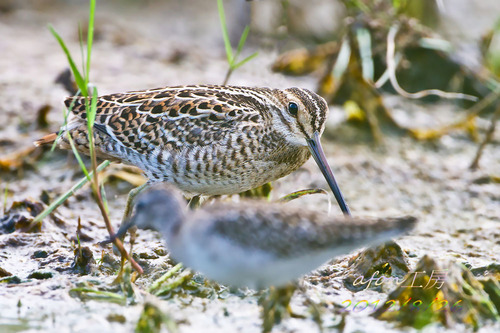
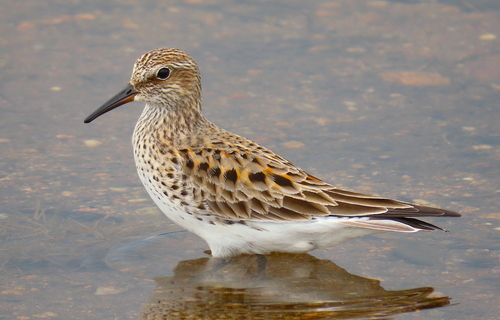
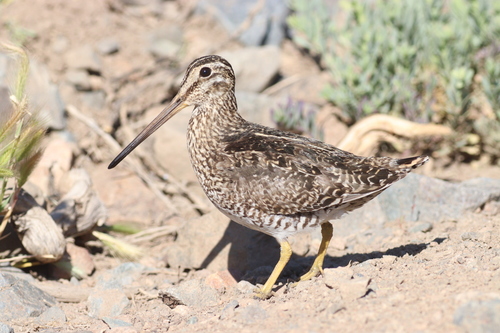
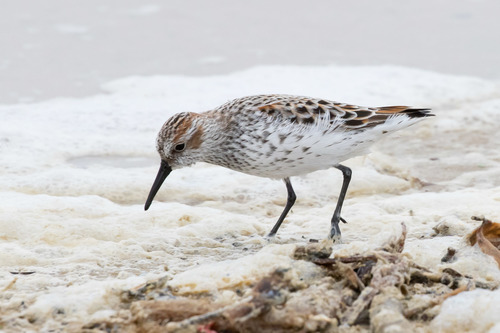
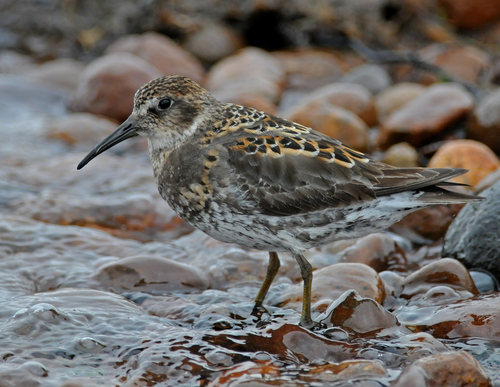
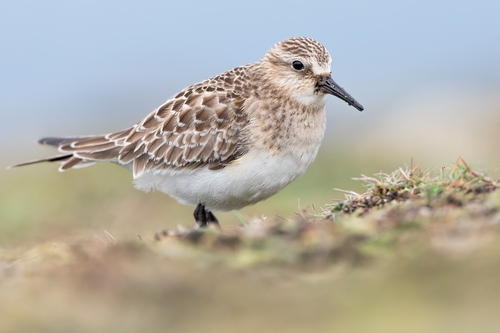
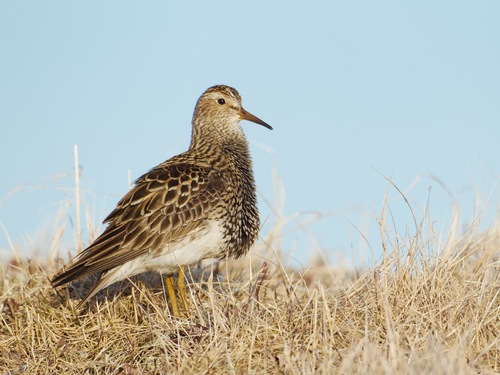
The pectoral sandpiper, Calidris melanotos, resembles the broadly sympatric sharp-tailed sandpiper (Calidris acuminata), though the two species do not belong to the same clade within the genus Calidris. This is a medium-large calidrid sandpiper, measuring 19–23 cm (7.5–9.1 in) in length with a 37–46 cm (15–18 in) wingspan. It has a grey-brown back: summer males show the brownest plumage, while winter birds are the greyest. It has a grey breast with a sharp, clear lower edge, the feature that gives the species its English name; this dividing line is especially noticeable when the bird faces the observer. Its legs are yellowish, and its bill is olive with a darker tip. On average, males are heavier than females, though there is extensive size overlap between the sexes. In breeding plumage, males also have a blacker breast marked with whitish spots. Juveniles have brighter patterning on their upperparts, with rufous coloration and white stripes along the mantle. This species can be distinguished from the sharp-tailed sandpiper by its prominent breast band, weaker supercilium, and browner, less rufous crown. Pectoral sandpipers are extremely long-distance migrants. Approximately half of the global population breeds on boggy tundra in northern Asia, while the remaining half breeds across a range from Alaska to central Canada. American and most Asian breeders winter in South America, but some Asian breeders winter in southern Australia and New Zealand. During migration and in winter, this species is typically found in freshwater habitats. It is a regular migrant to western Europe, and is seen every year in Ireland and Great Britain. Rare breeding has been recorded in the far north of European Russia and the far north of Norway, and vagrant individuals have been found in suitable breeding habitat in Scotland during summer. Many pectoral sandpipers seen in Western Europe may be migrating regularly from Asian breeding grounds to wintering grounds in Southern Africa. In September 2003, a major record influx of the species occurred in Ireland and Great Britain, with 40 individuals recorded in Ireland and 150 in Great Britain. Migrant flock staging like this is rarer along the U.S. Pacific coast. Vagrant individuals are occasionally observed outside of the species' usual migration routes, including Micronesia's Mariana Islands, Marshall Islands, and Palau; they are seen somewhat more often in the Hawaiian Islands. Like many Arctic-breeding birds, pectoral sandpiper migration is suspected to be affected by global warming. One hundred years ago, migrating individuals passed through northern Ohio in early to mid-May and again in late August. Today, the bulk of northward migration occurs in April, and most birds do not return until mid-September. These birds forage on grasslands and mudflats, locating food by sight and sometimes probing for it. Their diet consists mainly of arthropods including flies and their larvae, spiders, and crustaceans, plus other invertebrates and seeds. Males perform a courtship display that involves puffing up their breast; a fat sac develops in the breeding season to improve this display. The pectoral sandpiper builds a steep-sided scrape nest lined with a large volume of material. The nest is deep enough that the eggs sit roughly 3 cm (1.2 in) below ground level, which helps reduce heat loss from the cool winds common at the high latitudes where this species nests. Females lay a clutch of four eggs. The global population of pectoral sandpipers has declined by 50% since 1974.