About Calidris himantopus (Bonaparte, 1826)
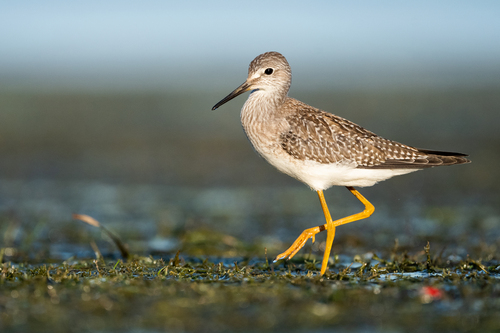
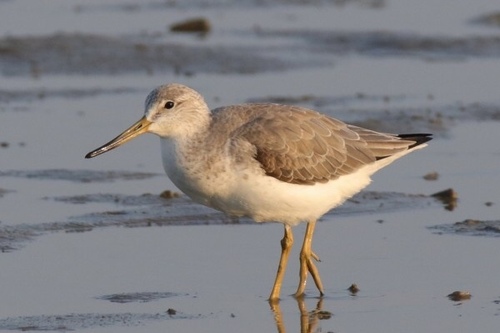
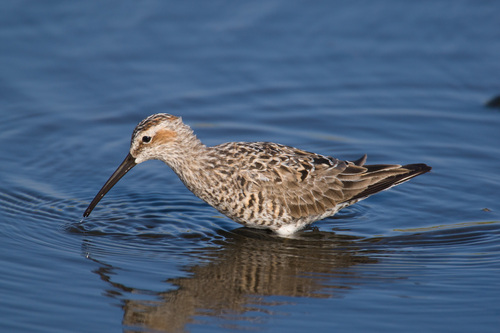
The stilt sandpiper, with the scientific name Calidris himantopus (Bonaparte, 1826), shares several traits with the curlew sandpiper: it has a long bill, long neck, pale supercilium, and white rump. It can be easily told apart from the curlew sandpiper by its straighter bill that is only slightly curved, not obviously curved, its longer greenish-yellow legs that are not black, and the total lack of a wingbar in flight. Breeding adult stilt sandpipers have a distinct appearance: their underparts are white with heavy blackish barring, and they have reddish-orange patches both above and below the white supercilium. Their back is brown with darker feather centers. In winter plumage, these birds are gray on the upper body and white on the lower body, and they retain a visible white supercilium. Juvenile stilt sandpipers share the strong head pattern and brownish back of adults, but do not have barring on their underparts, and their back feathers have white fringes. This species measures 18–23 cm (7.1–9.1 in) in length, has a wingspan of 37–42 cm (15–17 in), and weighs 50–70 g (1.8–2.5 oz). Stilt sandpipers breed in open arctic tundra in northern Alaska and northern Canada, in North America. They are long-distance migrants that winter mainly in central South America, ranging from southern Peru across to southern Brazil, and extending south to northern Chile and northern Argentina. Small numbers winter further north, in California, Texas, Florida, and Mexico. During migration, flocks stop to rest and feed on the muddy margins of freshwater pools, mostly in the eastern states and provinces of the United States and Canada, though small numbers occur as far west as the Pacific coast. It is a rare vagrant in western Europe, Japan, and Australia. This species forages on the muddy margins of pools, picking up food by sight, and often jabs for food like the dowitchers it frequently associates with. Its diet consists mainly of insects, other invertebrates including molluscs, seeds, and the leaves and roots of aquatic plants.