About Calidris ferruginea (Pontoppidan, 1763)
The curlew sandpiper, scientifically named Calidris ferruginea (Pontoppidan, 1763), is a small wader. It measures 18–23 cm (7–9 in) in length, weighs 44–117 g (1.6–4.1 oz), has a wingspan of 38–46 cm (15–18 in), a bill length of 32–44 mm (1.3–1.7 in), and a tarsus length of 26–34 mm (1.0–1.3 in). It has a black bill, dark brown irises, and dark grey to black toes and tarsi. All plumages have a large white patch on the rump, which is occasionally barred with red in some adults. In flight, it shows a distinctive white wing stripe along the tips, extending from the greater secondary coverts to the greater primary coverts.
Plumage varies by season and life stage. Non-breeding plumage has greyish upperparts and white underparts that sometimes have large grey streaks; as feathers wear, both upperparts and underparts gradually become browner. Upperpart feathers have darker centers, especially on the crest, that give the upperparts a mottled appearance. Upper tail coverts and lower rump feathers are white, with broad, pale grey rectrices. Primaries and secondaries are dusky, with white streaks along the shaft and a white tip. It has a distinct white supercilium, a stripe running across the head, paired with grey-brown lores, the area around the eyes, and auriculars, the feathers that protect the ear.
Moult timing and extent follow a consistent pattern. The post-breeding moult is a complete moult that replaces all feathers, occurring from July to November, and can last as late as the following April for some southern populations. The spring moult, occurring from January to May, is a partial moult that only replaces body feathers, not flight feathers.
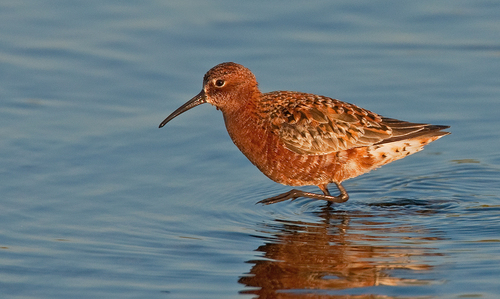
Returning breeding curlew sandpipers are sexually dimorphic. In females, the front of the body, entire head, and upper back have variable reddish tinting, with grey-to-dark streaks. Lower scapulars, feathers around the shoulder where the upper wing meets the body, alongside upperwing coverts and commonly tertials, the flight feathers closest to the body, have ruddy-silver tips and black centers, creating a spotty appearance. Upper tail coverts, upperwing coverts, the rump, and most flight feathers look nearly identical to their non-breeding appearance, with the exception of central rectrices and 2 to 3 tertials, which are off-black with white or ruddy fringing. Male plumage is similar to female plumage, except the rufous tinting is almost completely solid, with conspicuous spots above the eye and around the crown.
The pre-juvenile moult of chicks takes place at the nest site from late June to July. Juveniles look similar to adult non-breeding plumage, but have more evenly distributed wear marks and fringing, which creates a scaly, more buff-tinged appearance. Both the crown and nape are dusky with pale creamy streaks, and the nape is slightly paler; juvenile rectrices are tapered and narrower. The post-juvenile moult, occurring from October to December and able to finish as late as April, is a partial to incomplete moult that replaces body feathers and some flight feathers. This moult occurs almost entirely at stopover and overwintering sites, and only rarely starts at the breeding grounds. The pre-breeding moult of yearling birds, which occurs from April to June, is either absent or limited; body feathers are largely or completely replaced, but few if any flight feathers are replaced. The plumage of first-time breeders is similar to adult summer plumage, with the main difference being white spots or tufts on the underparts, which are fully, opaquely rufous rather than just tinted. Sex differences in first-time breeders match those of returning breeders.
In terms of distribution and habitat, curlew sandpipers are found across large areas of Afro-Eurasia during migration, and are notably absent east of the Verkhoyansk Range in eastern Siberia and across southern inland Asia during this period. They breed exclusively in the Siberian Arctic, from the Yamal Peninsula to Kolyuchin Bay. Their non-breeding range covers coastal regions of West Africa from Gabon to Mauritania, including Cape Verde, and southern Africa, spanning inland from Mozambique to Namibia to South Africa, and north through Uganda to Kenya. They also occur, though more rarely, inland from Niger to Chad, across the Republic of the Congo to Angola, along the Nile from Sudan to Egypt, and in southeastern Tunisia. They are much rarer along the coasts of Australasia, as well as inland Victoria and New South Wales. In New Zealand, they occur on the southeastern coast of the South Island and the entire coastline of the North Island. They also overwinter in coastal South Asia and Southeast Asia, and do not overwinter anywhere else in Eurasia. The curlew sandpiper is a common migratory vagrant in North America, particularly along the Atlantic Seaboard.
During the non-breeding season, curlew sandpipers are most often found on sheltered mudflats, as well as salt pans and wetland edges. In inland areas, they occupy the edges of various bodies of water, especially those with muddy or sandy margins, and can also be found along sewage ponds. They use both coastal and inland wetlands during migration. During the breeding season, they mostly stay in lowland tundra near bogs, depressions, or pools, staying away from scrub and other dense vegetation.