About Calidris falcinellus (Pontoppidan, 1763)
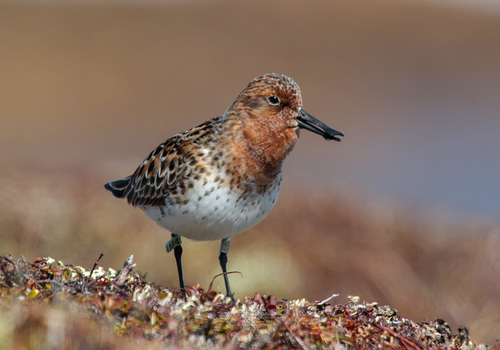
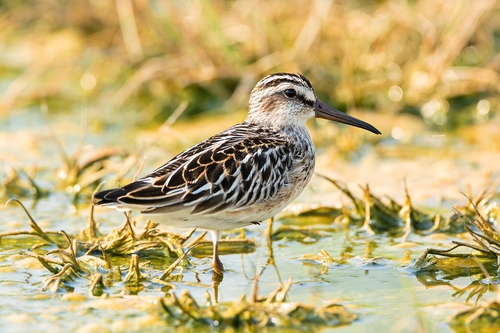
The broad-billed sandpiper, with the scientific name Calidris falcinellus (Pontoppidan, 1763), is a small wader. It measures 16–18 cm in length: it is slightly smaller than the dunlin, but larger than the little stint. It has a longer, straighter bill with a tip that is distinctly kinked downward, and shorter legs than the dunlin. Breeding adults have dark brown upperparts patterned with narrow, pale feather fringes, and white underparts with blackish markings on the breast. They have a pale crown stripe and a distinctive double (split) supercilium. As the species' English name suggests, its bill is slightly broader than the bills of most other Calidris species, but this characteristic, a feature often noted in museum specimen observations, is rarely noticeable in the field. The species has two subspecies that differ in the feather fringing of their summer plumage: fringing is narrow and white in C. f. falcinellus, and brighter with a rufous tone in C. f. sibirica. Winter plumage is much paler and greyer on the upperparts, and white on the underparts, similar to the winter plumage of a dunlin, but the broad-billed sandpiper retains its distinct head pattern year-round. Juveniles have backs that are similar to the backs of young dunlins or little stints, with pale "tramlines" running down the mantle, but their white flanks and belly and brown-streaked breast are distinctive for this species. The species' contact calls are a dry, whistling dree-it, dree-it and a clicking dik dik, which are similar to the calls of the little stint. The broad-billed sandpiper is a strongly migratory bird. It spends the non-breeding season from the easternmost part of Africa, through south and south-east Asia, to Australasia. It is gregarious, and forms mixed flocks with other scolopacid waders, particularly dunlins. Even though it has a European breeding range, this species is rare when passing through western Europe, which is due to its south-easterly migration route. The bird's breeding habitat is wet taiga bogs in Arctic northern Scandinavia and Siberia, split into two disjunct regions that correspond to the species' two subspecies. Males perform an aerial display during courtship. Pairs nest in a ground scrape, and lay four eggs. They forage in soft mud on marshes during the summer and on coasts during the winter, mainly picking up food by sight. They mostly eat insects and other small invertebrates.