About Calidris canutus (Linnaeus, 1758)
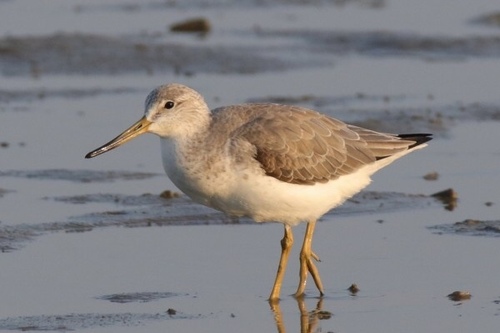
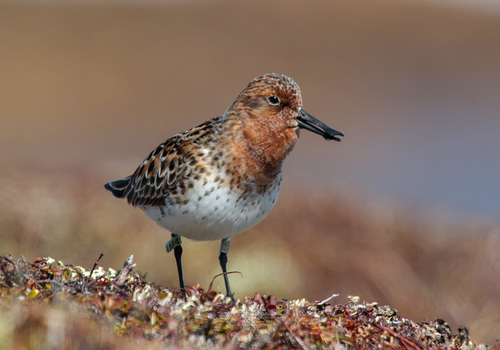
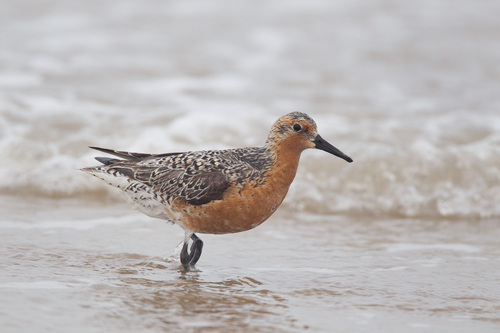
Calidris canutus, commonly known as the red knot, is the third or fourth largest species in the Calidris genus of sandpipers, ranking after the great knot, male ruff, and the similarly sized surfbird. It measures 23–26 cm (9.1–10.2 in) in length, with a wingspan of 47–53 cm (19–21 in), and has a body shape typical of the genus: a small head and eyes, a short neck, and a slightly tapering bill that is no longer than its head. It has short dark legs and a medium-thin dark bill. In winter plumage, both sexes develop uniform pale grey coloration that looks identical between males and females. In breeding plumage, the upperparts are mottled grey, the face, throat and breast are cinnamon-colored, and the rear belly is light-colored. Female breeding plumage is nearly identical to male breeding plumage, except that it is slightly lighter and has a less distinct eye-line. Three subspecies — C. c. canutus, C. c. islandica, and C. c. piersmai — are classed as darker-plumaged. Subspecies C. c. rogersi has a lighter belly than either C. c. roselaari or C. c. piersmai, and C. c. rufa has the lightest overall plumage of all subspecies. The moult from breeding to winter plumage begins at the red knot's breeding site, but the most extensive moulting occurs during southwards migration. The moult to breeding plumage starts just before northwards migration to breeding grounds, and is completed mostly during the migration period. In flight, the red knot is easy to identify thanks to its large size, white wing bar, and grey rump and tail. When feeding, its short dark green legs give it a characteristic 'low-slung' appearance. When foraging alone, red knots rarely call, but flocks in flight produce a low monosyllabic knutt call, and migrating birds utter a disyllabic knuup-knuup. Red knots breed in moist tundra from June to August. Males perform a display song called poor-me, a fluty call. The male's display involves circling at height with quivering wing beats, then tumbling to the ground with wings held upward. Both sexes incubate eggs, but the female abandons parental duties after hatching, leaving all care to the male. Juvenile red knots in their first year have distinctive submarginal lines and brown coverts. In the breeding season, males can be distinguished from females only with difficulty: identification based on plumage is less than 80% accurate compared to molecular methods. Males have a more even shade of red underparts that extend further toward the rear of the belly. The red knot's weight varies by subspecies, ranging between 100 and 200 g (3.5 and 7.1 oz). Red knots can double their body weight before migration. Like many other migratory birds, they reduce the size of their digestive organs ahead of migration. This organ atrophy is less pronounced than in species such as the bar-tailed godwit, likely because red knots have more opportunities to feed during migration. Red knots can also adjust the size of their digestive organs seasonally. When feeding on harder foods on wintering grounds, the gizzard grows thicker, and it shrinks in size when feeding on softer foods on breeding grounds. These changes happen very rapidly, occurring in as little as six days. During the breeding season, the red knot has a circumpolar distribution across the high Arctic. After breeding, it migrates to coasts around the world to winter at latitudes from 60° N (Shetland) to 55° S (Tierra del Fuego). The red knot has one of the longest migrations of any landbird. Every year, some individuals of the subspecies C. c. rufa travel more than 14,000 km (9,000 mi) from the Arctic to the southern tip of South America, then make the reverse return trip. The exact migration routes and wintering grounds of individual subspecies remain somewhat uncertain. The nominate subspecies C. c. canutus breeds on the Taymyr Peninsula and possibly in Yakutia, migrates through Western Europe, and continues on to winter in western and southern Africa. C. c. rogersi breeds on the Chukchi Peninsula in eastern Siberia, and winters in eastern Australia and New Zealand. Small and declining numbers of C. c. rogersi — or possibly the later-described C. c. piersmai — winter on mudflats in the Gulf of Mannar and along India's eastern coast. The recently split subspecies C. c. piersmai breeds on the New Siberian Islands and winters in north-western Australia. C. c. roselaari breeds on Wrangel Island in Siberia and in north-western Alaska, and apparently winters in Florida, Panama and Venezuela. C. c. rufa breeds in the Canadian low Arctic and winters in South America. C. c. islandica breeds in the Canadian high Arctic and Greenland, migrates through Iceland, and winters in Western Europe. Red knots wintering in west Africa restrict their daily foraging to an intertidal range of just 2–16 km2 (0.77–6.18 sq mi), and roost at a single site for several months. In temperate regions such as the Wadden Sea, red knots change roost sites each week, and their weekly feeding range can reach as much as 800 km2 (310 sq mi). For a bird of its size, the red knot is long-lived. One bird ringed at Brora in northern Scotland as a first-winter individual in October 1978 (when it was 3–4 months old) was resighted alive at Den Helder in the Netherlands in February 2006, 27 years, 3 months, and 29 days after ringing. Another C. c. rufa individual tagged as B95 and nicknamed 'Moonbird' was at least 20 years old at its last sighting in May 2014. As one of the longest-distance migrants in the animal kingdom, the red knot relies heavily on the same stopover sites each year along its migration routes to refuel before continuing its journey between wintering and breeding areas. Red knots travel in larger flocks than most shorebirds, covering 9300 miles from south to north every Northern Hemisphere spring, then repeating the trip in reverse every autumn. They spend Northern Hemisphere winters in Tierra del Fuego, South America, and migrate to breeding locations on islands and mainland above the Arctic Circle for the short Arctic summer. These long journeys are split into segments of roughly 1500 miles each, ending at annual, recurring staging areas. The Delaware Bay is the most critical migratory rest stop for the red knot. It meets most of the bird's physiological needs during migration by providing an abundant source of the red knot's main food at this stage: horseshoe crab eggs. The red knot and the horseshoe crab have an evolutionarily intertwined relationship, as the red knot's arrival at Delaware Bay coincides with the annual horseshoe crab spawning season there. Data supports the hypothesis that the abundance of horseshoe crab eggs on beaches including those of Delaware Bay drives the red knot's movement and distribution, and the size of the local horseshoe crab population defines the site's importance to the red knot's migration route. Other stopover sites in the United States include islands off the coasts of Massachusetts, Virginia, South Carolina, and Georgia. Fewer red knots take overland migration routes and winter on the Gulf Coast. Stopover areas on this route are located in the Mississippi river drainage, Northern U.S. saline lakes, and plains in Southern Canada. Ahead of migration, red knots go through a series of physiological changes to prepare for the physical demands of their long journey: flight muscle mass increases, while leg muscle mass decreases; stomach and gizzard masses decrease, while fat mass increases by more than 50 percent. They arrive at stopover sites extremely thin. Since their gizzard has shrunk for travel, they cannot eat many hard foods, so they seek out soft, nutritious horseshoe crab eggs as their preferred food source. Their migration is timed to match the release of horseshoe crab eggs, which are widely available at these specific stopover locations, making the resource easy to find and easy to digest, which saves the birds energy. This makes the abundance and accessibility of horseshoe crab eggs at these locations the reason for the species' tightly intertwined relationship. Red knots can nearly double their body weight during 10–14 day stopover stays by constant feeding, building up enough body fat to complete the rest of their journey. Delaware Bay's large horseshoe crab population makes it the most important stopover habitat for migrating red knots, supporting an estimated 50 to 80 percent of all migrating rufa red knots each year. Because red knot survival is directly tied to the abundance of horseshoe crab eggs, the health of the horseshoe crab population is key to understanding fluctuations in red knot populations. In the early 20th century, horseshoe crabs were harvested for fertilizer and animal feed, and today they are harvested for use as bait by U.S. fishing companies. This harvest caused horseshoe crab populations to decline, and red knot numbers in Tierra del Fuego (wintering) and Delaware Bay (spring stopover) fell by about 75 percent between the 1980s and 2000s. Overharvesting of crabs in the 1990s led to population management action from the Atlantic States Marine Fisheries Commission, which established mandatory state-by-state harvest quotas and created the 1,500-square-mile Carl N. Shuster Jr. Horseshoe Crab Sanctuary off the mouth of Delaware Bay. Since these management measures were put in place, commercial horseshoe crab harvest for bait has been reduced through population management and innovative bait conservation techniques, and red knot populations have correspondingly stabilized.