About Calidris bairdii (Coues, 1861)
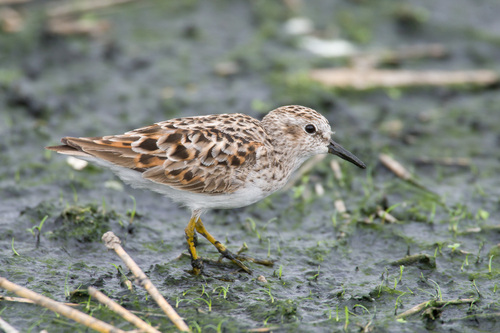
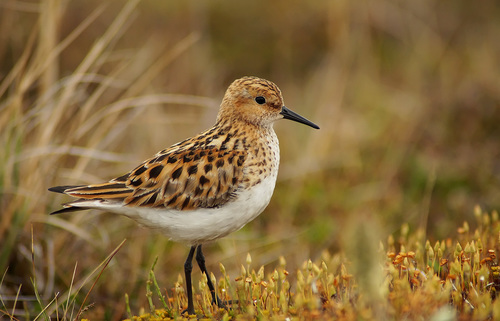
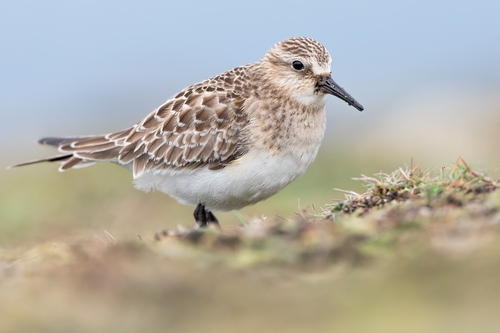
Adult Baird's sandpiper (Calidris bairdii) have black legs and a short, straight, thin dark bill. Their upperparts are dark brown, and their underparts are mainly white, with a black patch on the rump. The head and breast are light brown with dark streaks. In winter plumage, this species is paler brownish-grey on the upperparts.
This bird can be hard to tell apart from other similar tiny shorebirds, which are collectively called "peeps" or "stints". One of the best features for identification is its long wings, which extend past the tail when the bird is on the ground. Only the white-rumped sandpiper also has this trait, and that species can be distinguished by its characteristic white rump patch.
Baird's sandpiper breeds in the northern tundra, ranging from far eastern Siberia to western Greenland. It nests on the ground, usually in dry locations with low vegetation. It also breeds on barren high arctic coasts and hills.
This is a long-distance migratory species, which winters in western and southern South America, from Peru as far south as Tierra del Fuego. It is a rare vagrant to western Europe. During migration and in winter, it regularly uses lake shores and sparse grassland at extreme high altitudes, reaching up to 4,700 m in the Andes.
Baird's sandpiper may have hybridized with the buff-breasted sandpiper. These birds forage by moving across mudflats, picking up food by sight. They mainly eat insects, and also consume some small crustaceans.