About Calidris acuminata (Horsfield, 1821)
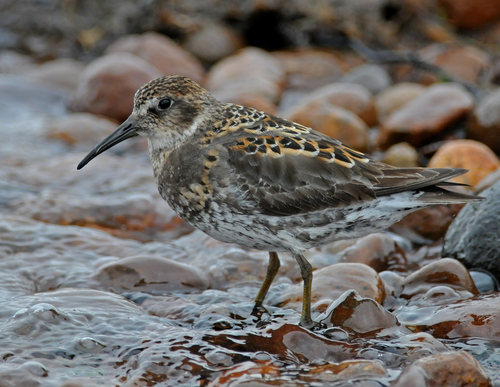
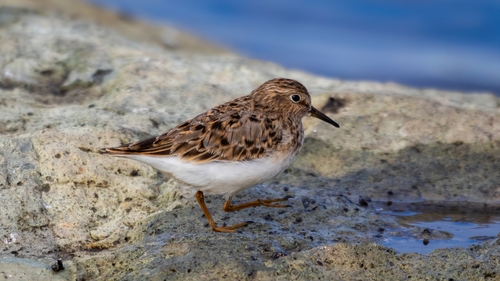
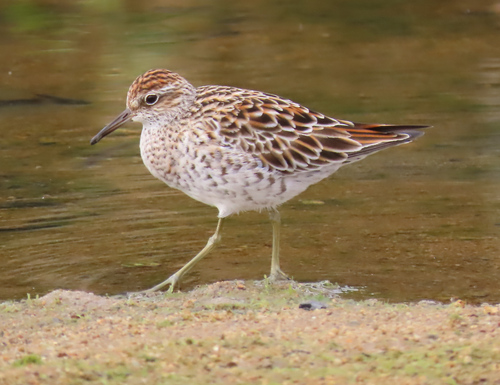
Calidris acuminata, commonly called the sharp-tailed sandpiper, is a small-to-medium portly wader with a pot belly, flat back, and a somewhat elongated rear end. Its upper body is mottled chestnut-brown, with distinct feathers that each have a dark centre; it also has a chestnut cap on its head and a brown stripe running through each eye. The bill is straight, and ranges from dark grey to black, while the legs are olive to yellow. The underparts are white or pale, with mottling matching the pattern on the breast and sides of the belly. Plumage is more vivid during breeding season, and duller in winter. Juveniles are brighter in autumn and early winter than adults, with sharper feathers and brighter chestnut crowns that contrast with white mantle stripes and bright buffy chests. The sharp-tailed sandpiper is most similar in appearance to the pectoral sandpiper, and breeds within the Asian range of the pectoral sandpiper. It differs from pectoral sandpiper in its breast pattern: it lacks a strongly demarcated breast band, and instead has '>'-shaped marks on the flanks. It also has a stronger supercilium and a more chestnut-coloured crown. It shares some similarities with the long-toed stint, but is much larger. The sharp-tailed sandpiper is strongly migratory, and breeds only in eastern Siberia, from the Taymyr Peninsula to Chaunskaya Bay in Chukotka. It has a complex migration: adults depart Siberia in July, and juveniles depart in August to head south, with the majority of the population wintering in Australasia. The species takes two main migration routes. Most post-breeding adults fly south in flocks of fewer than 1000, travelling east of Lake Baikal to the Pacific coast of Russia and the Yellow Sea coasts of China, Korea, and Japan. Most of these birds fly directly to Micronesia and New Guinea in late August, then depart when the wet season begins to travel to northwest Australia in mid-September. They then begin moving toward southeast Australia, with numbers peaking there between December and February. The second route heads east, and is used by most juveniles and a small number of adults, which cross the Bering Strait into Alaska. They stay in Alaska from mid-August to late October to build up fat reserves, and are presumed to then make a direct non-stop trans-Pacific flight of more than 10,000 km to reach Australia and New Zealand. Some individuals continue south along the Pacific coast of North America into Washington, and less frequently reach California, and may occasionally reach Latin America; only two recent records exist from Panama and Bolivia. The sharp-tailed sandpiper occurs as a rare autumn migrant to North America, and is a very rare migrant in western Europe, with records from 11 different countries (mostly the United Kingdom) between August and October. It has also been recorded in the Middle East and Central Asia, with six records in Kazakhstan, and one each in Yemen and Oman. In the Indian Ocean, it has been documented four times (totalling 16 individual birds) at Christmas Island between October and December. There have been three recorded observations at Cocos Island in November and December, five records at the Chagos archipelago from September to December, and five records in Seychelles: one in July, two overwintering from September to February, and two on passage in November. It was recently documented in Mozambique, when it was recorded in southern Africa for the first time in 2018. In Siberia, its breeding habitat is mostly peat-hummock and lichen tundra. During migration passage between breeding and wintering areas, it favours the muddy edges of shallow freshwater or brackish wetlands with grass, emergent or inundated sedges, saltmarsh or other low vegetation. These habitats include swamps, lakes, lagoons, and pools near coasts, as well as inland waterholes, dams, saltpans, and hypersaline salt lakes. In Alaska, the species appears to prefer coastal moist graminoid meadows and riverine intertidally exposed mudbanks. In Australia, it is largely found around wetlands, and prefers inland freshwater wetlands with grassy edges. After ephemeral terrestrial wetlands dry out, it tends to be seen on coastal mudflats, salt marsh, and brackish lagoons, and less often in similar wet short-grass fields. Other locations it has been spotted in Australia include around sewage farms, flooded fields, mangroves, rocky shores, and beaches.