About Calicium glaucellum Ach.
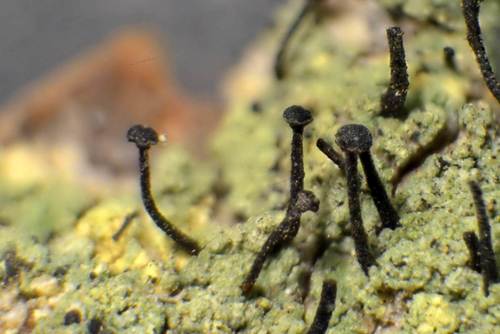
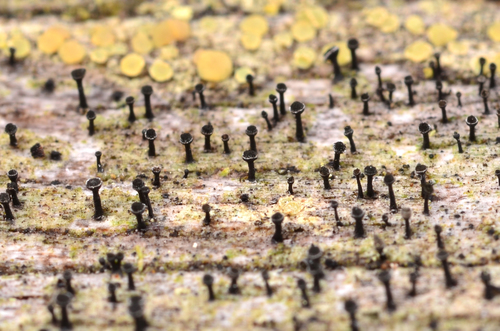
Calicium glaucellum Ach. is a lichenized fungus. Its thallus is typically immersed within its substrate, though it rarely grows superficially; when superficial, it is thin, indistinct, dark grayish green, and has a granular texture. The apothecia of this species usually have a faint white pruina, at minimum along the upper edge of the exciple and below the capitulum. Apothecia measure 0.5-1 mm in height, and are 4 to 9 times as tall as the width of their stalk. The stalk is shiny black, 0.11-0.17 mm wide, and made up of blackish brown to dark aeruginose, irregularly interwoven, strongly sclerotized hyphae that become paler toward the stalk's surface. The outermost layer of the stalk is paler and has a distinct, gelatinous, hyaline coat. The capitulum is obovoid to lenticular, with a diameter of 0.23-0.34 mm. The exciple is dark brown to aeruginose, formed from elongated to nearly isodiametric sclerotized hyphae that are paler in the outer section of the exciple and arranged distinctly in an anticlinal pattern. The hypothecium is dark brown, with a flat or slightly convex upper surface. The asci are cylindrical, measuring 35-41 μm by 3.5-4.5 μm, and hold uniseriate spores. Ascospores are ellipsoid, 9-13 μm by 4-6.5 μm, and have a coarse irregular ornamentation made of cracks and ridge fragments. Semi-mature spores have a very irregular sulcate pattern, consisting mainly of longitudinally arranged ridges that are broken up by irregular cracks. Pycnidia are frequently present, and produce narrowly cylindrical conidia that measure 4-5 μm by 0.8 μm. In terms of ecology and distribution, Calicium glaucellum grows on old stumps and standing or fallen wood of both coniferous and deciduous trees, and more rarely grows on bark. It is often found in exposed situations. The species occurs in the northern boreal to temperate zones of North, Central, and South America, as well as in Australasia. Within the Sonoran region, it has been recorded from southern California and Chihuahua.