About Calendula officinalis L.
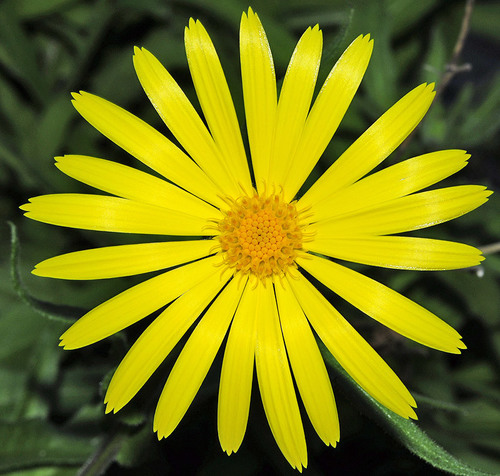
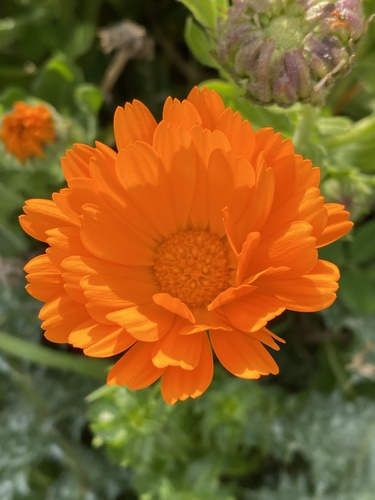
Calendula officinalis L. is a short-lived aromatic herbaceous perennial. It grows to 80 cm (31 in) tall, with sparsely branched lax or upright stems. Its leaves are oblong-lanceolate, 5–17 cm (2–7 in) long, hairy on both sides, with margins that are entire, or occasionally waved or weakly toothed. Its inflorescences are yellow or orange, and form a thick capitulum (flower head) 4–7 cm (1+1⁄2–3 in) in diameter, surrounded by two rows of hairy bracts. Wild plants have a single ring of ray florets surrounding central disc florets. The disc florets are tubular and hermaphroditic, and generally a more intense orange-yellow than the female, tridentate peripheral ray florets. The flowers can bloom year-round where growing conditions are suitable. Its fruit is a thorny curved achene. This species is probably native to southern Europe, though its long history of cultivation means its exact origin is not known. It is also widely naturalized further north in Europe, reaching as far north as southern England, and elsewhere in warm temperate regions across the world. Calendula officinalis is used as a food plant by the larvae of some Lepidoptera species, including the cabbage moth, gothic moth, large yellow underwing, and setaceous Hebrew character. Calendula officinalis is widely cultivated, and grows easily in sunny locations in most types of soil. Although it is a perennial, it is commonly treated as an annual, particularly in colder regions where winter survival is poor, and in hot summer locations where it also does not survive. Many gardening experts consider calendulas among the easiest and most versatile flowers to grow in a garden, especially because they tolerate most soils. In temperate climates, seeds are sown in spring to produce blooms that last through the summer and well into fall. In areas with limited winter freezing, seeds are sown in autumn for winter color. Plants will wither during subtropical summers. Seeds germinate readily in full sun or partial shade, but plants grow best in sunny locations with rich, well-drained soil. Pot marigolds (as they are commonly called) typically bloom quickly from seed (within under two months), with flowers in bright yellows, golds, and oranges. Most cultivars have a spicy aroma. Regular deadheading (removal of dying flower heads) is recommended to maintain consistent blossom production. The florets of Calendula officinalis are edible. They are often added to salads for their color, or used as a garnish in place of saffron. While the leaves are also edible, they are generally not considered palatable, though they were historically added to potherbs and salads. The plant is also used to make herbal tea. In ancient Greek, Roman, Middle Eastern, and Indian cultures, the flowers were used as a medicinal herb and as a dye for fabrics, foods, and cosmetics. Many of these uses remain common today. Calendula is also used to produce an oil that is widely added to skin care products. Marigold leaves can be made into a poultice that is believed to help scratches and shallow cuts heal faster and prevent infection. It has also been used in eye drops. Plant extracts are also widely used in cosmetics, likely due to the presence of compounds including saponins, resins, and essential oils. The flowers are a rich source of lutein, containing 29.8 mg per 100g of flower.