About Calectasia narragara R.L.Barrett & K.W.Dixon
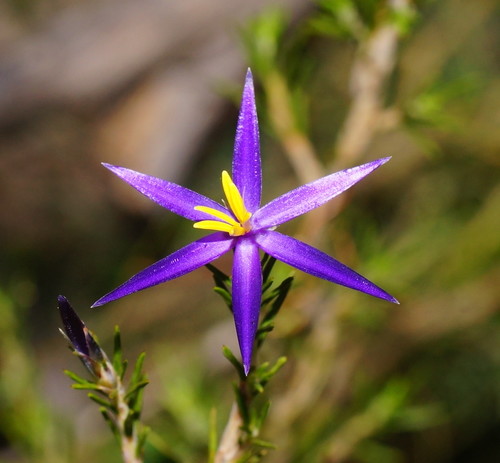
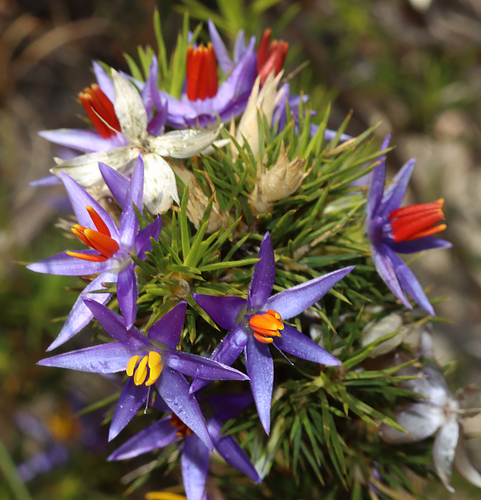
Calectasia narragara is an undershrub that lacks stilt roots, and grows from a short rhizome which allows it to form clones. Its roots are clustered, wiry, and bind sand. The species grows to around 50 centimetres (20 in) tall, and has many very short side branches. Each leaf blade is glabrous, except occasionally at the margins, and measures 4.2–14.5 millimetres (0.2–0.6 in) long and 0.4–1.0 millimetre (0.02–0.04 in) wide, tapering to a short, sharp point at the tip. The base of the petals, which are technically tepals, forms a tube 8.9–10.2 millimetres (0.35–0.40 in) long that is glabrous; this is unlike most other species in the genus, with the exception of C. hispida. The outer portion of the petals is blue with bronze margins, and spreads outward to form a papery, star-like shape that fades to white as the flower ages. Six yellow stamens in the centre of the star form a tube that turns orange-red with age. The thin style sometimes extends beyond the stamens. This species resembles other Calectasia species, and can be told apart from them by a combination of features: its short, compact rhizome, lack of stilt roots, glabrous leaf blades, and the age-related colour change of its petals and stamens. Flowers mostly occur from June to September. This blue tinsel lily species is widespread and common within 80 kilometres of the coast, on the Swan Coastal Plain and Darling Scarp, extending from Busselton north to Geraldton in the South West Botanical Province. It typically grows in a wide range of habitats and vegetation associations, including kwongan, woodland growing on white, grey, or yellow sand, and occasionally in swampy areas.