About Caleana major R.Br.
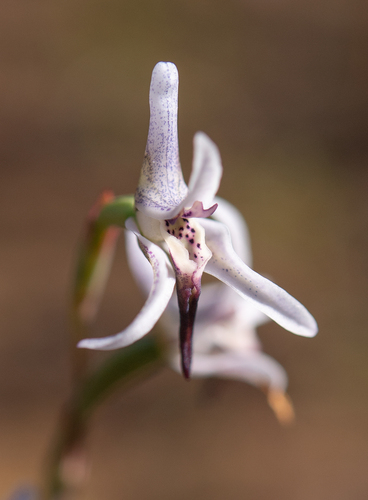
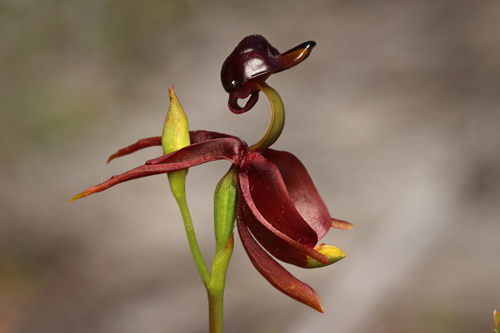
Caleana major R.Br. is a tuberous perennial herb that typically grows to a height of 200–400 mm (8–20 inches). A single reddish, narrow lance-shaped leaf emerges at the base of the plant; this leaf is 40–130 mm (2–5 inches) long, 4–8 mm (0.2–0.3 inches) wide, and often has spots. Up to five shiny reddish brown flowers grow on a thin, wiry flowering stem. Each flower is 20–25 mm (0.8–1 inch) long and 6–7 mm (0.2–0.3 inches) wide. Rarely, flowers may be greenish with dark spots. The sepals and petals are 12–15 mm (0.5–0.6 inches) long and end in pointed tips. The column has broad wings that the dorsal sepal and petals nearly touch, while the lateral sepals fold back behind the flower in a wing-like shape. The labellum is 6–8 mm (0.2–0.3 inches) long and 5–6 mm (0.20–0.24 inches) wide, and resembles a duck's head attached to a strap-like neck. Flowering takes place from September to January.
Commonly called the flying duck orchid, Caleana major is found in Queensland, New South Wales, Victoria, South Australia and Tasmania. It grows in eucalyptus woodland, coastal or swampy shrubland, and heathland. It grows mostly near the coast, but can occasionally be found at higher altitudes.
This species is pollinated by insects. The labellum is held above the flower by a sensitive strap-like stalk. When touched, the labellum swings rapidly downward, trapping visiting insects between the labellum and the column wings. Caleana major has proven difficult to keep in cultivation. Plants will flower for one, or sometimes two years, but gradually weaken until they die.