About Calcinus verrillii (Rathbun, 1901)
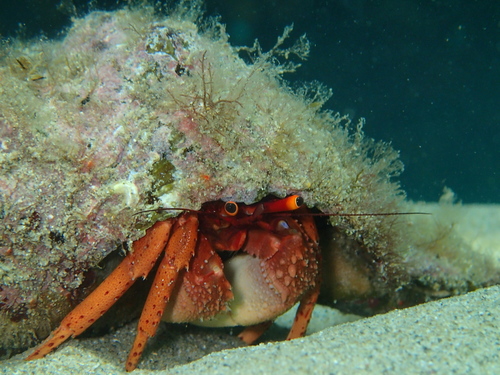
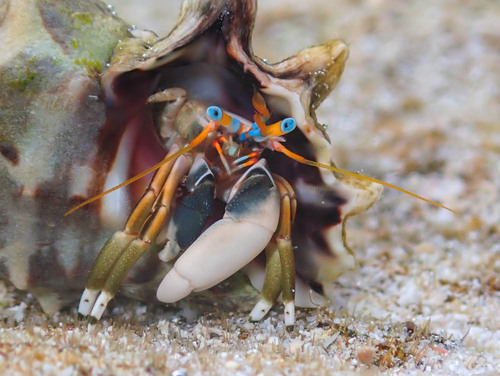
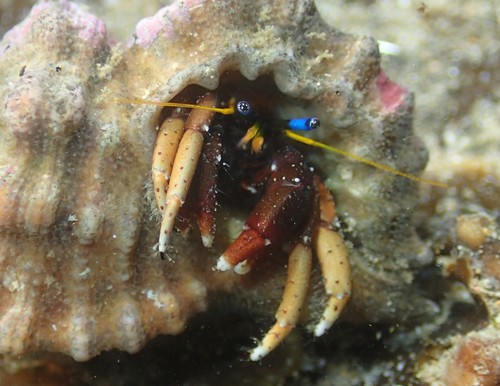
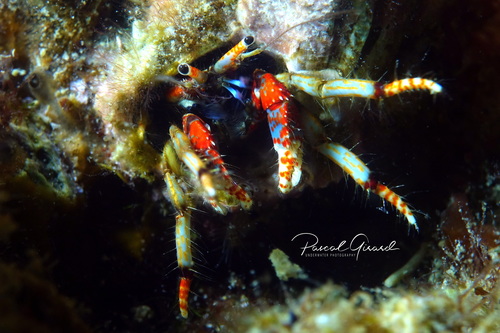
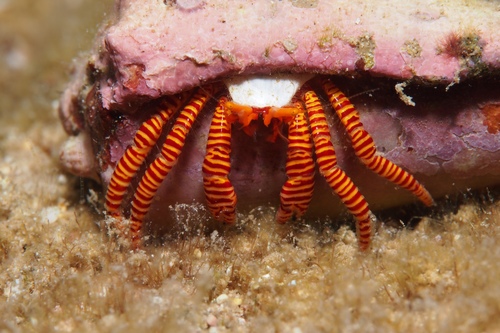
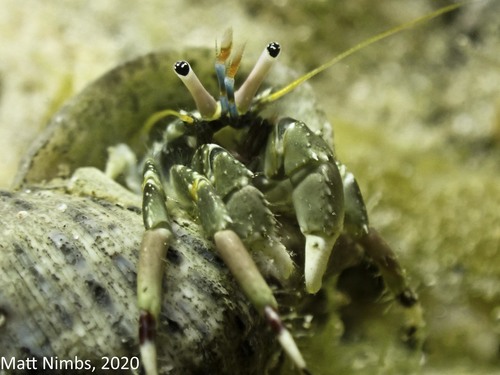
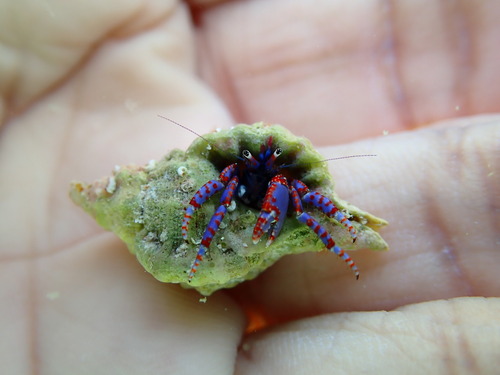
Like other species in the genus Calcinus, Calcinus verrillii has a robust, calcified carapace, eight thoracic segments, and six or seven abdominal segments. Its carapace and legs are spotted with purple and orange; it has slender eyestalks, and its front three pairs of walking legs are smooth and hairless. Its soft abdomen is coiled to fit into the mollusc shell that this hermit crab uses for protection, and uropods at the tip of the abdomen grip the inside of the shell. Calcinus verrillii is native only to Bermuda, and does not occur naturally anywhere else. It is mostly found in the subtidal zone, and has been recorded at depths down to 110 metres (630 ft). It is uncommon in intertidal areas and rock pools, but is abundant on reefs and rocks with strong water movement. As a hermit crab, Calcinus verrillii must find suitable empty gastropod mollusc shells to live in as it grows. It most commonly inhabits shells of Cerithium litteratum, but empty shells can sometimes be scarce. On occasion, this hermit crab will instead live in the calcified tube of the vermetid gastropod Spiroglyphus irregularis. It also sometimes uses the tubes of the turritellids Vermicularia knorrii and Vermicularia spirata. These tubes are normally attached to rocks, and when occupying an attached tube, the hermit crab loses the ability to move freely to gather algae fragments from the rock or scavenge for food. Instead, it becomes a filter feeder. The benefits of occupying a tube as a shell include being less likely to be swept off the rocks by strong water movement, and plenty of food being carried to it by the current. Female Calcinus verrillii grow larger than males, and are more likely to occupy these tube shells.