About Calcinus tubularis (Linnaeus, 1767)
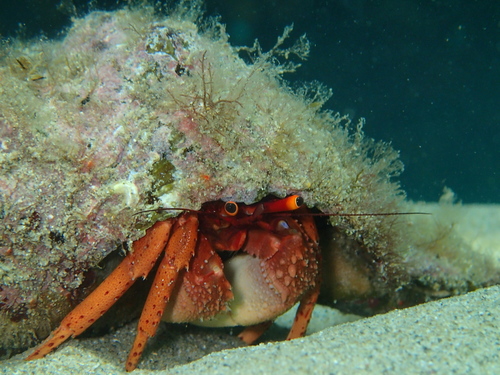
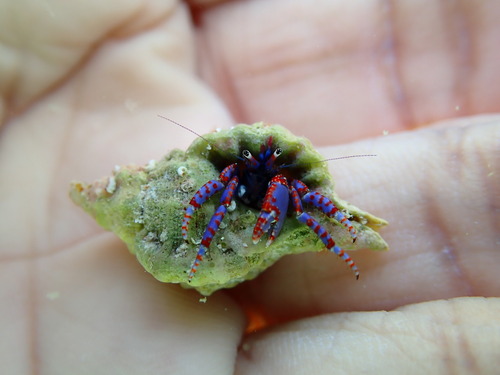
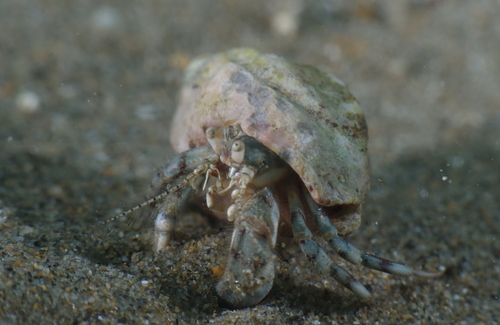
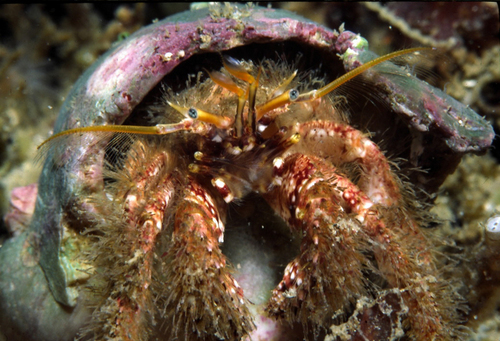
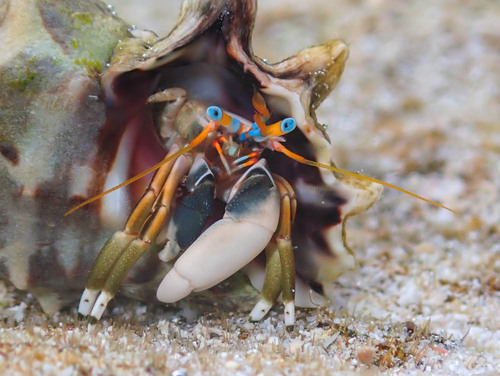
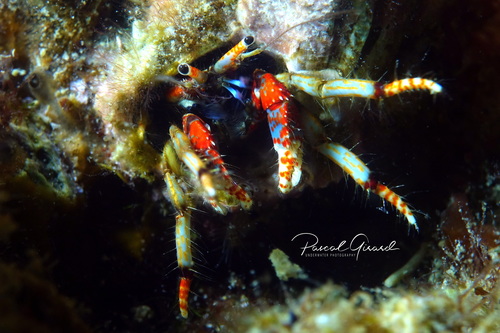
Calcinus tubularis has a bluish carapace covered in numerous red spots, and it extends forward into a short, triangular rostrum. Its eyestalks are white with the same kind of red spotting; this red spotting also appears on the last segment of each walking leg, and on both the fixed and movable fingers of its claws. This species occurs in two colour forms, dark and light, and this variation appears to be connected to camouflage, especially for females. C. tubularis is a normal-sized species for the genus Calcinus, and its carapace width frequently grows wider than 3 millimetres (0.12 in). The genus Calcinus has its centre of diversity in the central Pacific Ocean, and only two species of the genus are found in the north-eastern Atlantic: Calcinus paradoxus and Calcinus tubularis. C. tubularis is primarily a Mediterranean species, with a range stretching from Madeira in the west to Lebanon in the east. There are outlying occurrence records from Madeira, the Canary Islands, Cape Verde and Ascension Island. Even though C. tubularis has distinctive colouration, its sedentary behaviour lets epibionts colonise the shells it occupies, creating excellent camouflage that lets the species go easily unnoticed. It was first recorded on the coast of mainland Portugal in 2011, but it is thought to have lived there for a long time already. Calcinus tubularis is a rare species that lives below the intertidal zone. It is one of only two hermit crab species, the other being the closely related C. verrilli, where sexual dimorphism in shell use has been observed. Males live in gastropod shells, mostly those of Pisania maculosa or Cerithium vulgatum, and can move freely within these shells. Females instead occupy the fixed tubes built by the vermetid snail Lementina arenaria. The only parasite known to infect Calcinus tubularis is a rhizocephalan barnacle, likely from the genus Septosaccus. The species is also targeted by another barnacle, Trypetesa lampas, which acts as an egg predator for many different species of hermit crabs.