About Calcinus morgani Rahayu & Forest, 1999
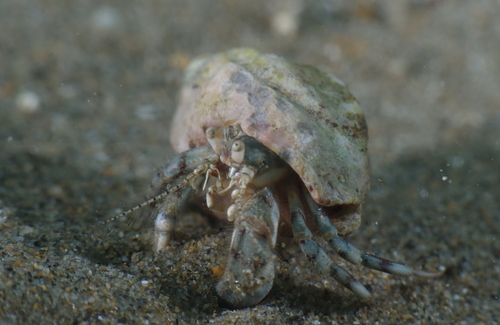
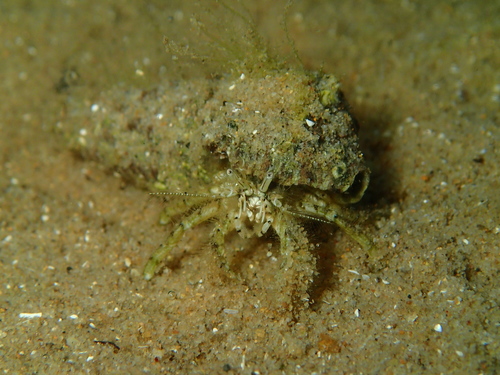
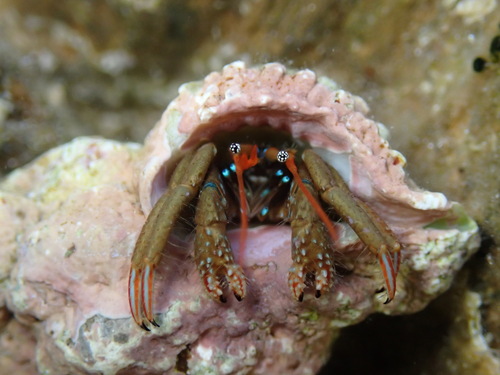
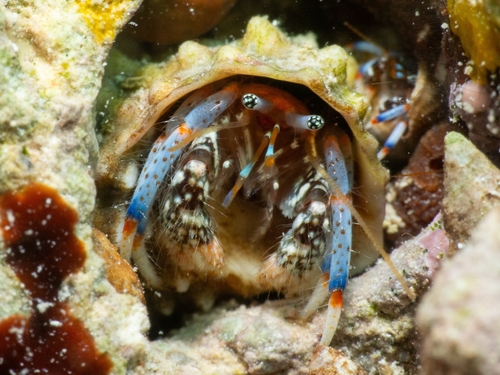
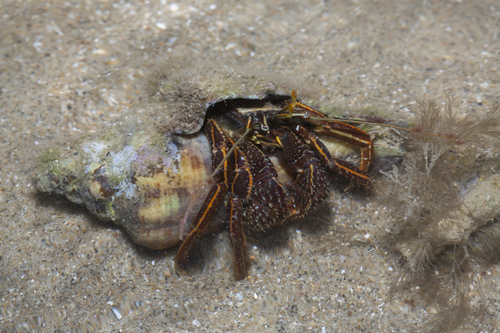
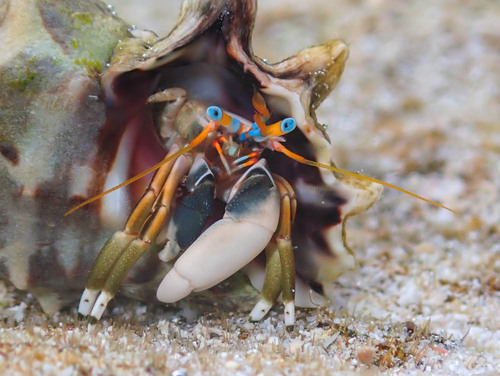
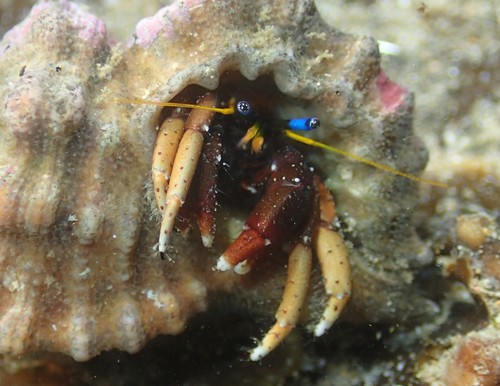
This species of hermit crab, Calcinus morgani, has a shield that is 1.15 to 1.4 times longer than it is wide. Its rostral lobe is triangular, while its lateral projections are very small and blunt. The eye-stalks have inflated bases, and are nearly as long as the shield. The left claw (cheliped) has four to six robust calcified teeth along its cutting edge, and the dactyl of this claw has two to four teeth along its cutting edge. The right cheliped is somewhat smaller than the left and has fewer teeth. Small tubercles and low protuberances dot the surfaces of both chelipeds. The third pair of walking limbs (pereopods) has a brush of bristles (setae) near the claw, while all other pereopods only have scattered setae. Coloration of this species follows a distinct pattern: the shield is whitish with dark brown margins, the eye-stalks are bright blue with brown bases, the antennal appendages are dark brown and orange, the chelipeds are dark brown with white tips and white tubercles, and the pereopods are dark brown with white bands near the claws. Calcinus morgani was once considered to be the same species as Calcinus gaimardii, but C. gaimardii can be easily distinguished: it has a dark brown front half of the shield, lacks bright blue on its eye stalks (which are entirely orange, with only a small amount of blue on the corneas). Calcinus morgani is distributed across the tropical and subtropical Indo-Pacific region, with a range that extends from Madagascar to western, northern, and eastern Australia, the Philippines, Indonesia, and other western Pacific island groups. It typically inhabits the intertidal zone of coral reefs and rocky shores that are exposed to strong wave action. This habitat preference differs from that of C. gaimardii, which prefers sheltered inlets and lives subtidally.