About Calcinus laevimanus (J.W.Randall, 1840)
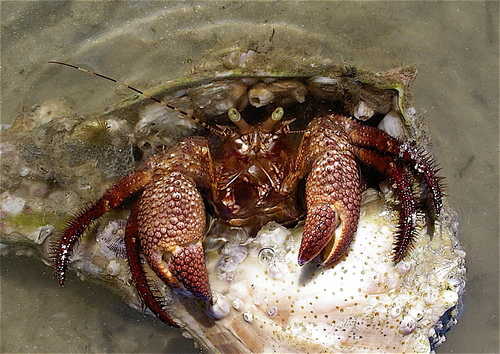
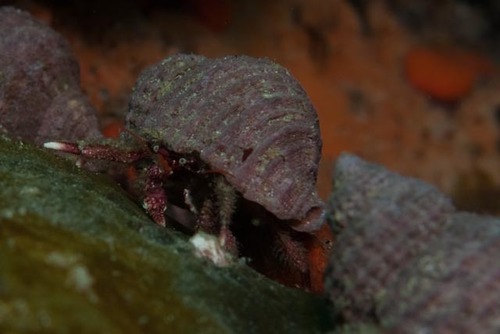
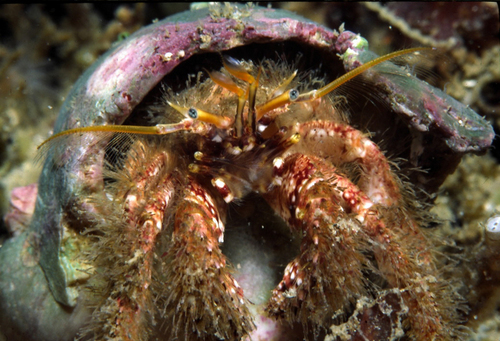
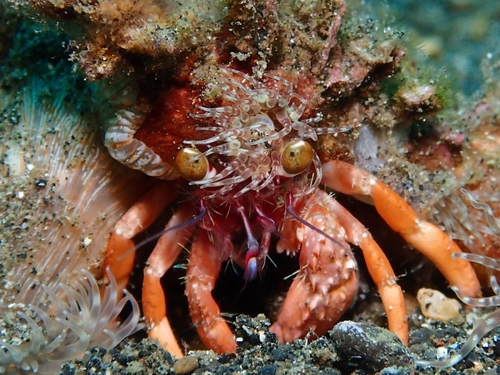
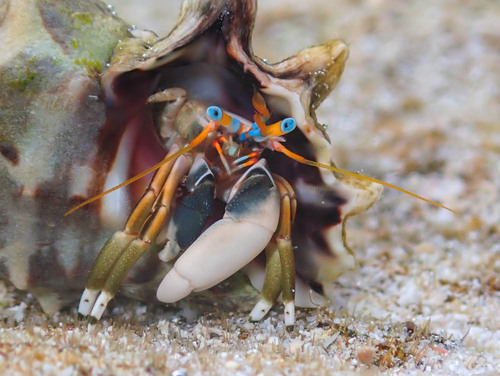
Calcinus laevimanus is a species of hermit crab first described by J. W. Randall in 1840. The anterior portion of its body is calcified, while the posterior portion, which is protected by the shell the crab inhabits, is not. The species reaches a total length of up to 30 mm (1.2 in), with a shield length of up to 8 mm (0.3 in), and males are usually larger than females. Its eyestalks are long, slender, and inflated at the base. The left cheliped (claw) is much larger than the right one. The propodus, the penultimate joint of the cheliped, is smooth and shiny, and the finger and thumb have spoon-shaped, calcified tips. The general color of its carapace ranges from brown to grey. The eyestalks are blue at the base and orange towards the distal end. The first pair of antennae have blue bases and orange tips, while the second pair are entirely orange. The chelipeds are purplish-brown, with white fingertips. The walking legs are orangish-brown with white tips. This species is native to the tropical and subtropical western Indo-Pacific. Its range extends from East Africa, Madagascar and the Comoros, through Indonesia, the Philippines, Australia and Papua New Guinea to Hawaii, and it includes many western Pacific archipelagoes. It typically occurs between the low intertidal zone and upper subtidal zone, most often on rocky reefs, exposed rock, and coral rubble. When selecting a new shell to occupy, this hermit crab prefers globose-shaped shells, especially those from the Turbo and Nerita genera. In Hawaii, individuals frequently occupy shells of Trochus intextus and Turbo sandwicensis, while in South Africa, empty Lunella coronata shells are the preferred choice. C. laevimanus is an aggressive hermit crab species that will fight to claim empty shells and other resources. The size and brightness of the white patch on its left chela appears to act as a status signal, helping the individual during agonistic interactions with other crabs. Like other decapods, female C. laevimanus carry their eggs tucked under their abdomen. In Hawaii, 80% of females carry eggs between February and October, with a typical clutch size of around three thousand eggs. After hatching, larvae develop through six zoeal stages and one glaucothoe stage before maturing.