About Calcinus elegans (H.Milne-Edwards, 1836)
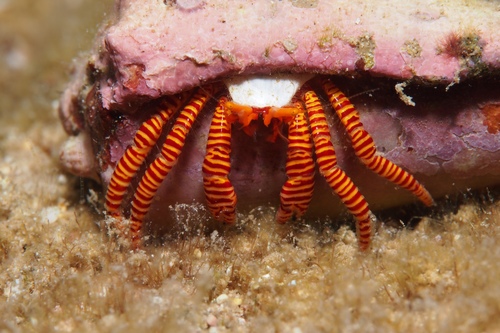
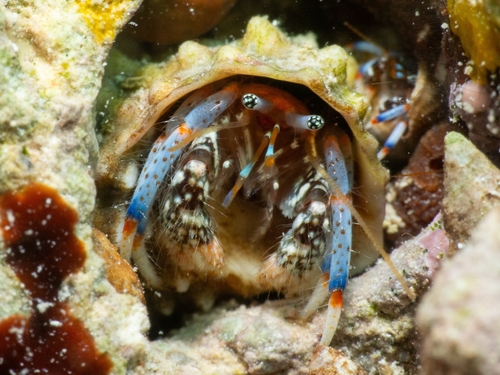
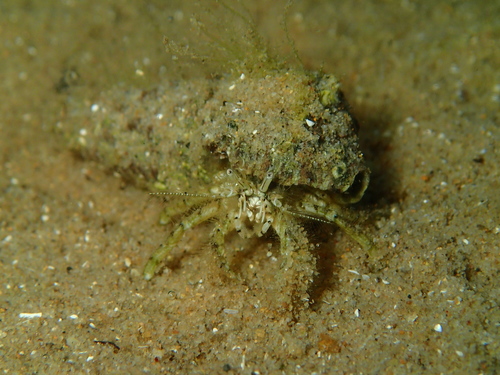
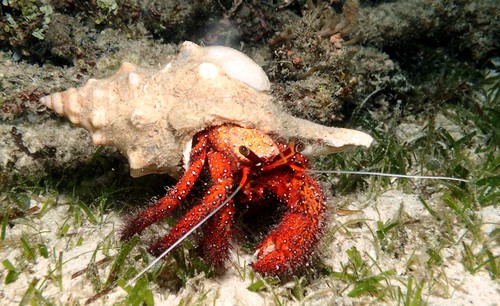
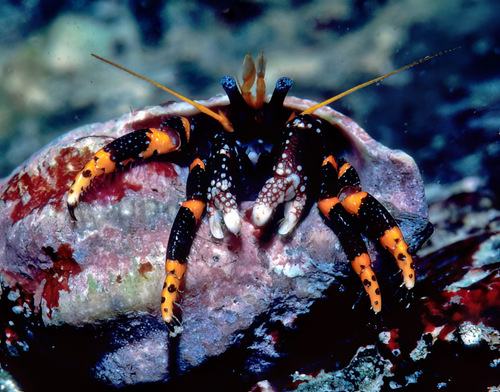
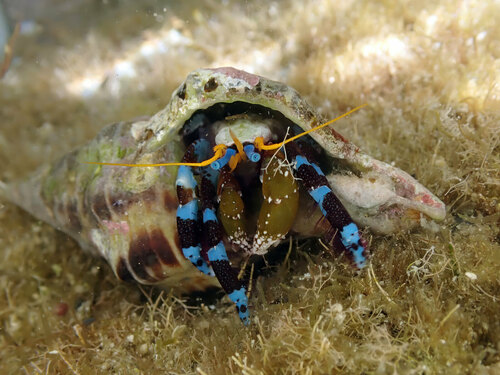
Calcinus elegans, commonly called the blue line hermit crab, follows the standard body plan of arthropods, with a segmented head, thorax, and abdomen. As a decapod, it has five pairs of legs: one pair has evolved into specialized sharp claws called chela, while the other four pairs are ambulatory legs that it uses to support the heavy gastropod shell it inhabits, with its soft abdomen kept shielded inside the shell. This hermit crab has a distinctive, colorful pattern: its legs have alternating bright blue and black stripes, its chela are olive green with white speckles at their tips, two bright blue eyes extend out from the shell, and it has two orange antennae and two orange antennules. It also has maxillae that help move food particles into its mouth. Morphological features of this species vary based on the habitat the individuals live in. For example, Hawaiian Calcinus elegans have orange bands on their ambulatory legs, while Indo-Pacific individuals from Java, Bali, and Lombok Islands have pure blue bands instead. Calcinus elegans is unique among all species in the Calcinus genus because it is the only species covered in small hairs called setae. Calcinus elegans primarily lives in shallow tidal and subtidal regions of the Indo-West Pacific, ranging from Eastern Africa to island chains just south of Hawaii. It can also be found in the tropical U.S. Virgin Islands near Puerto Rico, and has been reported at multiple locations across Japan, including the Ryukyu Islands, Izu, Ogasawara, Kochi, Boso, and the Kii Peninsula. Its distribution generally follows the equator, occupying tropical habitats with warm ocean temperatures, clear waters, and low primary productivity. These habitats have a depth range of 0–20 meters (0–66 feet), a sea surface salinity range of 30–35 ppt, and a sea surface temperature range of 20–30 °C (68–86 °F). Before mating, blue line hermit crabs display distinct pre-mating behaviors that include the male rotating the female's shell, or rubbing his chelipeds against the opening of the female's shell. Unlike most crustaceans, Calcinus elegans does not do a shell exchange during mating. Though typically reclusive, this hermit crab sometimes forms relationships with other marine organisms. Some cnidarians settle and grow polyps on the hard surface of the hermit crab's shell. In this mutualism, the cnidarians defend the crab from predators with their stinging cnidae and may reduce how often the crab needs to switch shells. In exchange, the hermit crab provides the cnidarians with a place to settle and transport to new environments that may hold more detritus or microorganisms, which are nutrient sources for the cnidarians. However, these relationships are not always purely beneficial or symbiotic: some cnidarians interfere with the hermit crab's reproduction and can even increase the crab's risk of predation. The hermit crab only stays in the symbiosis if the benefits it gains outweigh the costs; if costs become too high, the crab will abandon its shell and find a new one. Algae also use Calcinus elegans' shells as a settling surface, and many of the species' shells are crusted with coralline algae. This coralline algae creates a strong, smooth surface for coral polyps to settle on, which may enable the symbioses that form between corals or other cnidarians and this hermit crab.