About Calbovista subsculpta Morse ex M.T.Seidl
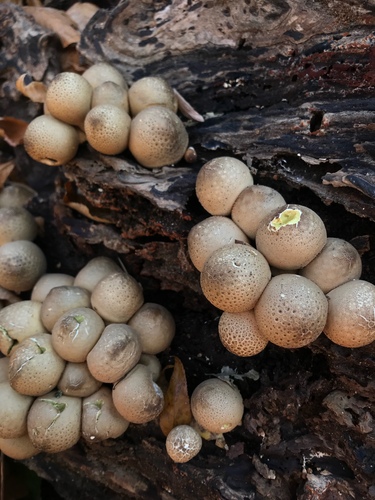
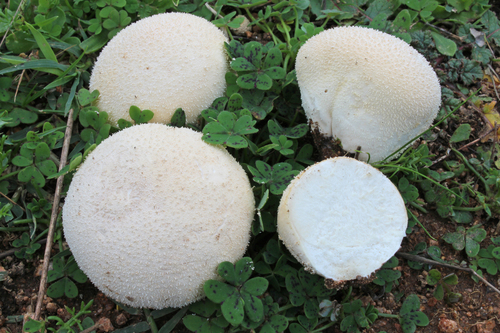
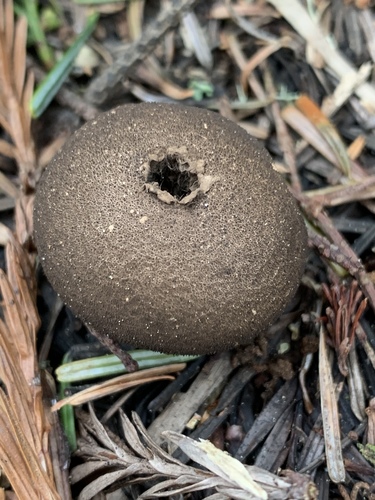
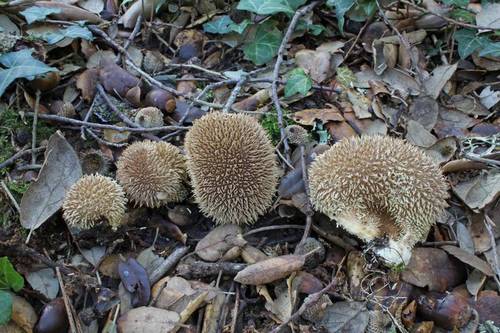
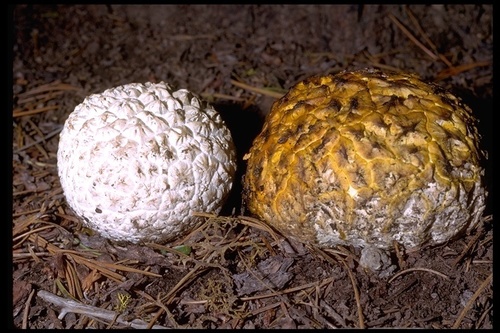
Calbovista subsculpta fruit bodies are irregularly top-shaped to roughly spherical, measuring 8–15 cm (3–6 in) wide and 6–9 cm (2+1⁄2–3+1⁄2 in) high. This fungus has a two-layered peridium. The outer peridium layer, called the exoperidium, is thick and leathery, except where it thins toward the base, and measures 5–10 mm (3⁄16–3⁄8 in) thick. It is divided into irregular three- to six-sided, low pyramids that are usually blunt, but sometimes pointed. The pyramids are 5–8 mm (3⁄16–5⁄16 in) thick, and bear parallel markings; Morse attributed this feature to differences in growth rate caused by variations in daytime and nighttime temperatures. The centers of the pyramids have short brownish hairs. The pyramids cover the entire peridium except for the area near the base, which is smooth. Warts on the surface of young fruit bodies may be disproportionately thick. The inner peridium is a thin shiny tissue that is depressed into the areas demarcated by the pyramidal plates. The puffball base, which takes up about a quarter to a third of the bottom of the fruit body, is made up of moderately-sized chambers that persist even after the gleba has matured and spores have dispersed. The base can develop a purplish hue after weathering, and is rooted into the soil with rhizomorphs. Initially white, the gleba changes color from yellow to golden brown to dark brown as spores mature. As the gleba dries, the inner peridium dries and cracks, exposing the spore mass in cracks between the scales. The gleba is supported by a yellowish-brown to light brown subgleba. The flesh has no odor and a mild taste. The spore print is white, turning brownish. Spherical spores measure 3–5 μm, including an outer epispore covering of about 0.5 μm. Their surface texture ranges from smooth to faintly warted. They contain an oil droplet and have a translucent pedicel, a small stalk, up to 2.5 μm long. The spore-bearing basidia are club-shaped, four-spored, and measure 10–12.5 μm long by 5–7.5 μm wide. The capillitium is made of short, highly branched antler-like entangled threads that measure 5–10 μm wide with walls up to 2.5 μm thick, and capillitial threads do not have septa. Calbovista subsculpta is a saprobic species that decomposes dead plant material. Its fruit bodies grow singly, in groups, or occasionally in clusters. Fruiting occurs from April to August in areas with broken rocks mixed with soil, or in open coniferous forest at elevations ranging from 900 to 3,400 m (3,000 to 11,000 ft). Another common habitat for this species is alongside roadsides. It is a common mountain puffball, distributed across the Rocky Mountains and Pacific Coast ranges of the western United States. On the eastern side of the Cascade Range, the puffball is often found growing under ponderosa pine. It has been collected from California, Colorado, Idaho, Washington, Wyoming, and Oregon, and its range extends north to British Columbia and Alaska. Morel hunters often find this puffball in spring, since it grows in the same habitats that morels favor. The puffballs are edible when the interior gleba is still firm and white.