About Calappa hepatica (Linnaeus, 1758)
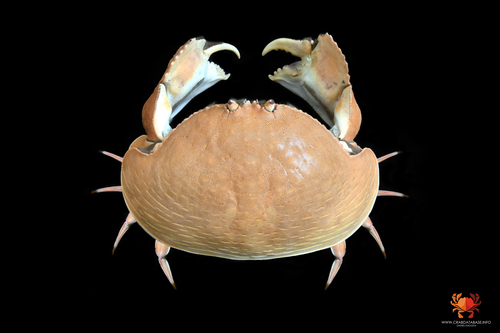
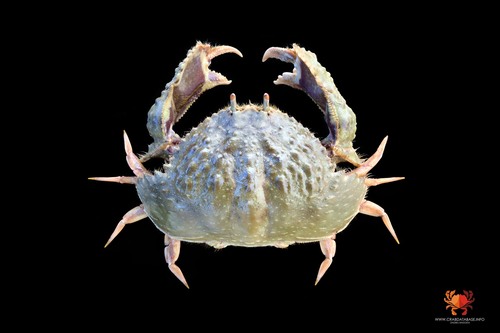
Calappa hepatica reaches a carapace width of roughly 4 cm (1.6 in), and its carapace length is always less than two-thirds of its width. Broad extensions with several blunt marginal teeth on the posterior portion of its shell largely conceal the crab's walking legs. The carapace and exposed sections of its chelae (pincers) are mottled greyish-brown, and covered in small raised tubercles of varying sizes. This gives the crab effective camouflage when it is semi-submerged in sand. Its chelae are large and powerful, specially adapted for crushing and consuming molluscs, which matches the species' feeding behaviour. This species occurs in tropical and subtropical parts of the Indo-Pacific, with a range that extends from the Red Sea to Hawaii, French Polynesia, Cocos Island, and northern Australia. It typically inhabits sandy or shelly sand seabeds, often found in reef habitats and seagrass meadows, at depths down to approximately 150 m (500 ft). During the day, Calappa hepatica stays buried in sand, with only the area around its eyes exposed. It emerges at night to hunt for prey, and can quickly and efficiently rebury itself in the substrate when threatened by danger. As a predator, it feeds mainly on bivalve and gastropod molluscs, as well as hermit crabs. It has a specially adapted right chela for breaking open prey shells: this claw has a large accessory tooth at the base of its hinged section, positioned opposite a flat plate on the claw's fixed part. The two structures work together like a vice. After opening the shell, it uses its left pincer — which is longer and more pointed than the right — to extract the soft internal tissues.