About Calamaria pavimentata Duméril, Bibron & Duméril, 1854
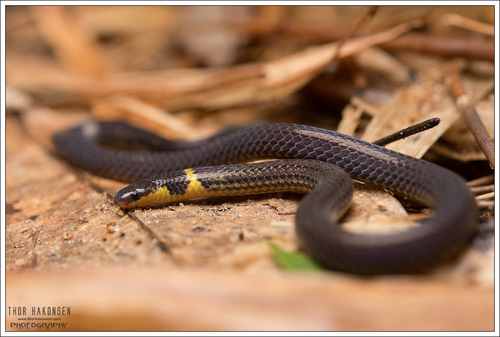
Calamaria pavimentata, commonly called the collared reed snake, can be identified by its distinct scale and color pattern. The rostral scale is as deep as it is broad, and is clearly visible from above. The frontal scale is longer than it is broad, shorter than the parietal scales, and 2.0 to 2.5 times as broad as the supraocular scale. This species has one preocular scale, one postocular scale, and four upper labial scales: the second and fourth are the largest, and the second and third extend into the eye socket. The first pair of lower labials forms a suture behind the mental scale. There are two pairs of chin shields, with each pair in contact with the other. Scales are arranged in 13 rows. This species has 140–182 ventral scales, an entire anal scale, 13–27 subcaudal scales, and a pointed tail. The upper body of the collared reed snake is reddish-brown, marked with five dark longitudinal lines or series of spots. The nape is dark brown, and separated from the back by a yellow collar. One pair of yellow spots sits at the base of the tail, and another pair sits at the tip of the tail. Undersides are uniformly yellow with a dark line running along the tail in specimens from Myanmar and Java; in the subspecies C. p. siamensis, the yellow base color is obscured by brown mottling, or undersides are brown with lighter borders. The total body length of this species reaches 12.5 inches (32 cm), with a tail that is 0.6 inches (1.5 cm) long. This snake is distributed across India (Assam), Myanmar, Thailand, Laos, Cambodia, Vietnam, west Malaysia (including Pulau Tioman), Indonesia, south and southwest China (including Hainan), Taiwan, and Japan (Ryukyu Islands). Its type locality is Java, Indonesia.