About Calamanthus fuliginosus (Vigors & Horsfield, 1827)
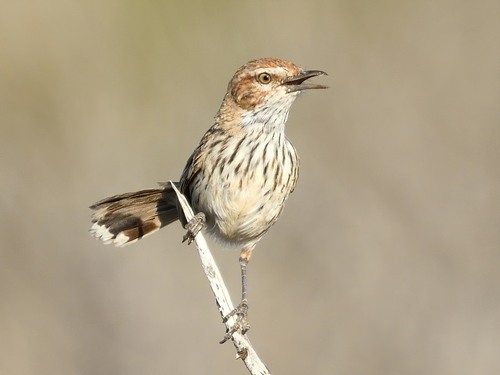
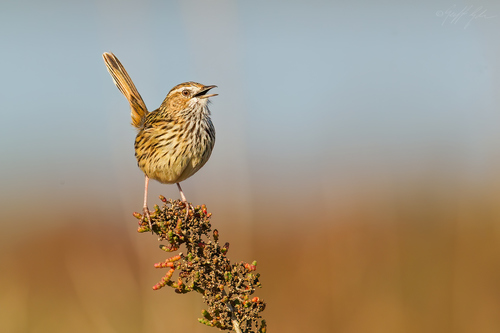
The striated fieldwren, scientifically named Calamanthus fuliginosus (Vigors & Horsfield, 1827), is a small bird that reaches 140mm in total size. Its overall plumage is light brown and olive, with a white belly and black streaks covering most of its body. It has a cocked whitish tail marked with black and brown streaks. The bird's underparts are buff-colored, patterned with dark gray and brown streaks, while its wings are brown and gray with darker, bolder streaks. The flight feathers lack streaks, and instead have fine light gray edges. A distinct whitish line runs over the bird's eye. Striated fieldwrens are hard to spot, because they forage quietly in thick vegetation or directly on the ground. When approached, they elevate their tails, and sometimes move their tails side to side, while continuing to sing until they feel trapped, at which point they will fly away to a new location. Even though the species can camouflage well in vegetation, they are easier to observe during spring. This small olive-brown bird lives in dense heath, grassland, and salt marsh habitats. It is commonly found across coastal areas of South Australia, Victoria, New South Wales, and Tasmania. Currently, the striated fieldwren is classified as a vulnerable species, because much of its habitat has been lost to land clearance and degradation. Because of human changes to its habitat, the species is most often recorded within national parks and reserves. Local population shifts have been noted within New South Wales. Within their habitat range, striated fieldwrens can be found alone, in pairs, or in small family groups in low bushes and shrubs.