About Calamagrostis canadensis (Michx.) P.Beauv.
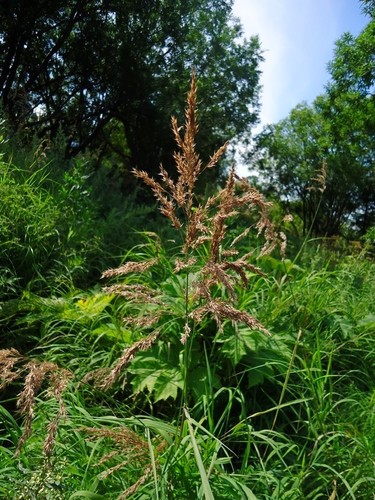
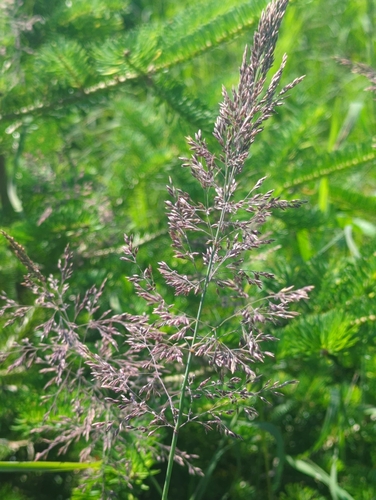
Calamagrostis canadensis (Michx.) P.Beauv. is a perennial grass with branching stems that grow to heights between 60 centimeters and 1.5 meters. Its flat, drooping leaves have a rough texture from tiny hairs. The inflorescence can reach up to 25 centimeters long, and it may grow as an open, loose structure, or as a narrow structure densely packed with spikelets. Each spikelet is roughly half a centimeter long and purplish in color. This species is a palatable food source for both livestock and wild grazing animals. It is a tough, rhizomatous grass that improves soil stability in wet areas, and it is one of the first plants to re-colonize sites after recent oil spills. It can become a nuisance during forest restoration projects, as it can outcompete conifer seedlings. The different varieties of this species often have overlapping distributions. It occurs across many habitat types, including forests, taiga, and tundra in subarctic regions. It is the most common and widespread Calamagrostis species on its continent.