About Caladenia sericea Lindl.
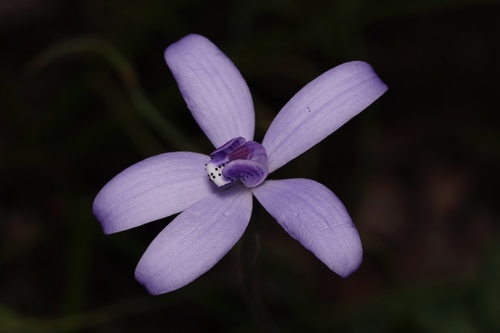
Cyanicula sericea, also known under the scientific name Caladenia sericea Lindl., is a terrestrial, perennial, deciduous herb. It grows from an underground tuber and produces a single soft, densely silky leaf that is 50–120 mm (2–5 in) long and about 20 mm (0.8 in) wide. Up to four pale blue or mauve flowers are borne on a stalk 150–400 mm (6–20 in) tall. Each flower measures 30–50 mm (1–2 in) long and 30–40 mm (1–2 in) wide. The dorsal sepal is erect, 20–30 mm (0.8–1 in) long and 5–8 mm (0.2–0.3 in) wide. The lateral sepals and petals are roughly the same size as the dorsal sepal. The labellum is 10–15 mm (0.4–0.6 in) long and 7–10 mm (0.3–0.4 in) wide, and is spotted with purple. The sides of the labellum curve upwards to surround the column, while the short curled tip bends downward and has short teeth along its edges. Four or six rows of purple calli run along the mid-line of the labellum. Flowering takes place from August to early October, and is far more prolific after summer fires. This species occurs in higher rainfall areas of Western Australia between Jurien Bay in the north and Esperance in the east. It is found in the Avon Wheatbelt, Esperance Plains, Jarrah Forest, Swan Coastal Plain and Warren biogeographic regions, and grows in forest, woodland and on granite outcrops.