About Caladenia longiclavata E.Coleman
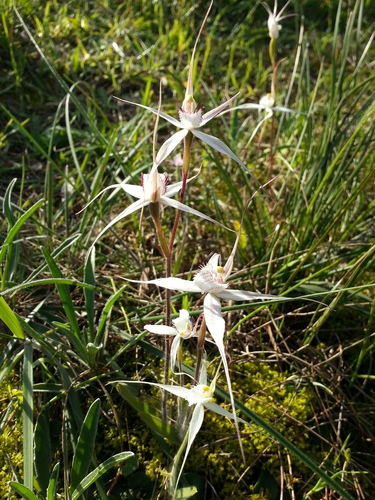
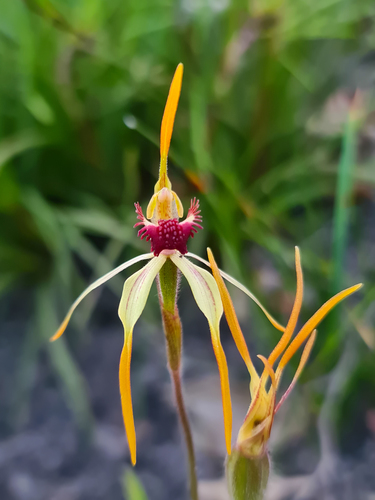
Caladenia longiclavata is a terrestrial, perennial, deciduous herb that grows from an underground tuber. It produces a single hairy leaf, 90–180 mm (4–7 in) long and approximately 2 mm (0.08 in) wide. One or two greenish-yellow, white and red flowers grow at the end of a 200–350 mm (8–10 in) tall flowering stem. Individual flowers measure 50–70 mm (2–3 in) long and 40–50 mm (1.6–2.0 in) wide. The sepals and petals have flattened, club-shaped, yellowish-brown glandular tips that are 5–20 mm (0.2–0.8 in) long. The dorsal sepal is erect, 25–45 mm (1–2 in) long and 2–4 mm (0.08–0.2 in) wide. The lateral sepals are 25–45 mm (1–2 in) long and 5–8 mm (0.2–0.3 in) wide; they turn stiffly downwards and lie nearly parallel to each other. The petals are slightly shorter and narrower than the sepals, and also curve stiffly downwards. The labellum is 13–18 mm (0.5–0.7 in) long and 7–14 mm (0.3–0.6 in) wide, yellowish with a dark red curled-under tip. The edge of the labellum bears narrow teeth up to 3 mm (0.1 in) long, and four or more rows of deep red calli up to 2 mm (0.08 in) long are crowded along its central midline. Flowering occurs from September to early November. This species, commonly called the clubbed spider orchid, is common and widespread between Perth and Albany in Western Australia’s Avon Wheatbelt, Esperance Plains, Jarrah Forest, Swan Coastal Plain and Warren biogeographic regions, where it grows in woodland and forest.