About Caladenia cracens D.L.Jones
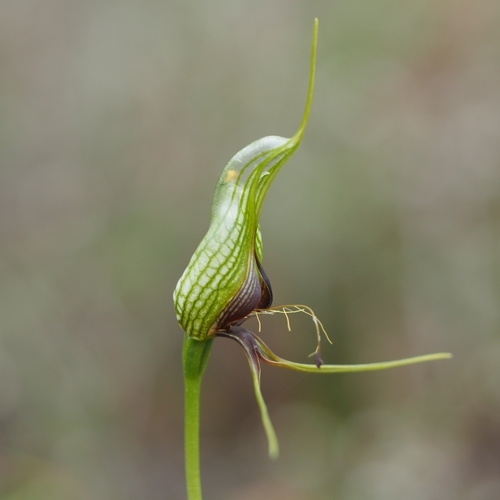
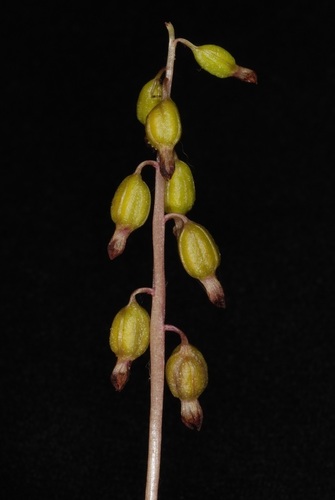
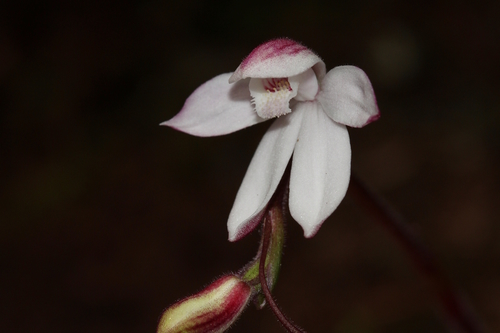
Caladenia cracens D.L.Jones is a terrestrial, perennial, deciduous herb with an underground tuber, that grows singly or in loose groups. It produces one single, sparsely hairy, narrow linear leaf that is 5–12 cm (2–5 in) long and 1–3 mm (0.04–0.1 in) wide. One single sweetly-scented flower, 20–25 mm (0.8–1 in) across, grows on a thin, wiry spike that is 8–15 cm (3–6 in) high. The dorsal sepal is egg-shaped with its narrow end toward the base, 8–12 mm (0.3–0.5 in) long, 3–6 mm (0.1–0.2 in) wide, and forms a hood over the labellum and column. The lateral sepals and petals are lance-shaped, 8–13 mm (0.3–0.5 in) long, 3–5 mm (0.1–0.2 in) wide, and range in color from pale to dark pink. The sepals and petals are glabrous on the front, but densely covered with glandular hairs on the back, and are held more or less horizontally, spreading away from each other. The labellum has three lobes, is broadly egg-shaped when flattened, curves forward, and measures 7–8 mm (0.28–0.31 in) long by 4–6 mm (0.16–0.24 in) wide. It has five to eight pairs of linear teeth along its edge, which decrease in size toward the front. Between two and four irregular rows of thin cream or yellow calli run along the central part of the labellum. The lateral lobes of the labellum are erect and partly surround the column. The column is about 6 mm (0.2 in) long and 2.5 mm (0.1 in) wide, green to whitish with red markings, and has narrow wings. Flowering occurs between late September and early November, and is followed by a papery capsule fruit. This species, commonly called elegant caladenia, is widespread in southern Tasmania, where it grows in woodland and forest, and occurs less commonly in heath.