About Caladenia carnea R.Br.
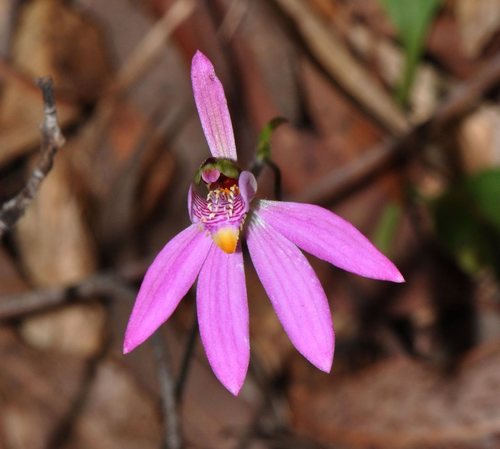
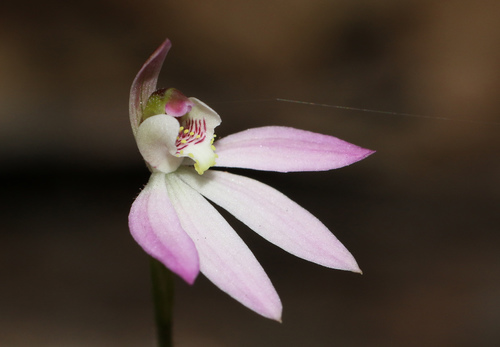
Caladenia carnea R.Br. is a terrestrial, perennial, deciduous herb that grows from an underground tuber. It produces a single, sparsely hairy, narrow linear leaf, which measures 90–150 mm (4–6 in) long and 3–4 mm (0.1–0.2 in) wide. Its inflorescence is a raceme that grows 120–250 mm (5–10 in) tall, and bears between one and three, and sometimes up to five flowers. The flowers may sometimes be sweetly scented or musky. The dorsal sepal is usually erect, 10–15 mm (0.4–0.6 in) long, and 2–4 mm (0.08–0.2 in) wide. The lateral sepals and petals are usually 8–15 mm (0.3–0.6 in) long; their outer surfaces are covered in glandular hairs, and are greenish-pink, sometimes with stripes, while their inner surfaces are pinkish or greenish white. The labellum is roughly egg-shaped, 5–8 mm (0.2–0.3 in) long and wide, and is white or pinkish with prominent red stripes. The sides of the labellum curve upwards, the central section has a toothed edge that usually bears yellow calli, and two lines of raised, club-like, yellow-tipped calli run through the centre. The column is curved, has red bars on its inner surface, and narrow wings along its sides. Flowering occurs between August and November, and after flowering the plant produces a non-fleshy, dehiscent capsule that holds a large number of seeds. This species is often confused with Caladenia fuscata; however, C. fuscata always produces only one flower per plant and flowers a few weeks earlier than C. carnea. Commonly called the pink fingers orchid, Caladenia carnea occurs in Queensland south from Hervey Bay, the eastern half of New South Wales, most of Victoria excluding the alps and far north west of the state, south-eastern South Australia, and Tasmania. It grows in a wide range of habitats including heath, scrubland, woodland, and forest, and prefers well-drained soil. It often survives land clearing activities.