About Caladenia cardiochila Tate
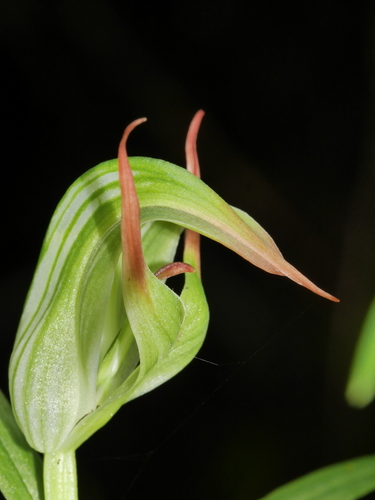
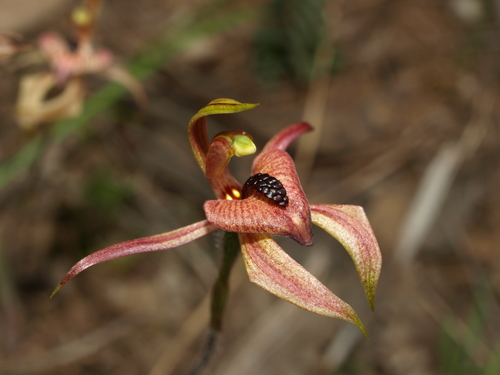
Caladenia cardiochila Tate is a terrestrial, perennial, deciduous herb that grows from an underground tuber. It produces a single, sparsely hairy leaf that is linear to lance-shaped, measuring 4–11 cm (2–4 in) long and 3–10 mm (0.1–0.4 in) wide. One or two flowers are borne on a slender, wiry, sparsely hairy spike that reaches 10–30 cm (4–10 in) in height. The sepals and petals are yellowish to greenish pink with a central red streak, though some individuals have entirely red flowers. The dorsal sepal is linear to lance-shaped, is either erect or curves forward, measures 15–30 mm (0.6–1 in) long and about 3 mm (0.1 in) wide. The lateral sepals are roughly the same length as the dorsal sepal but much wider, particularly near their middle, and are either parallel to each other or sometimes crossed. The petals are about the same length as the lateral sepals but much narrower, and either spread outwards or curve downwards. The labellum is yellowish-green to cream-coloured with red markings and a dark maroon or dark brown region near the tip. It is heart-shaped to broadly egg-shaped, 10–20 mm (0.4–0.8 in) long, and 8–15 mm (0.3–0.6 in) wide. It is flat, with slightly upward-curving sides and a downward-curving tip. There are no teeth along the edges of the labellum, but two to four rows of thick, club-shaped calli are present in the lower central part of the structure, and these do not extend towards the tip. Flowering occurs between August and November. This species of Caladenia is similar to C. tessellata, but can be distinguished by its generally larger flowers that lack teeth on the edge of the labellum, and its calli that do not extend to the labellum tip. Some individual plants have intermediate forms, suggesting the two species are not completely distinct or that hybrids between them occur. This Caladenia grows singly or in small groups in sandy soil within mallee heath, scrub, or forest in western Victoria and south-eastern South Australia. There is a single recorded occurrence from the northern part of Flinders Island dating to 1947, and the species is now considered extinct there.