About Caladenia caerulea R.Br.
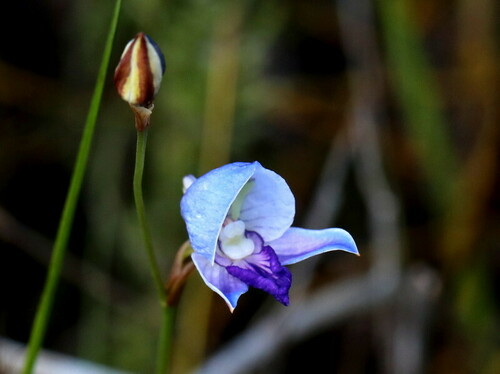
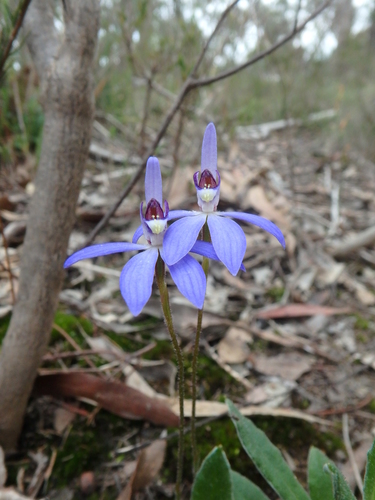
Caladenia caerulea (also referred to as Cyanicula caerulea) is a terrestrial, perennial, deciduous herb that grows from an underground tuber. It produces a single sparsely hairy leaf, 20–70 mm (0.8–3 in) long and 2–5 mm (0.08–0.2 in) wide, that usually lies flat on the ground. One flower, most often pale to dark blue, rarely white, 20–30 mm (0.8–1 in) in both length and width, grows on a stalk 50–150 mm (2–6 in) tall. The dorsal sepal stands erect, measures 12–16 mm (0.5–0.6 in) long and about 2 mm (0.08 in) wide. The lateral sepals and petals are 12–16 mm (0.5–0.6 in) long and 3–5 mm (0.1–0.2 in) wide, spreading like the fingers of a hand. The labellum is 7–9 mm (0.3–0.4 in) long and 6–8 mm (0.2–0.3 in) wide, blue with dark blue bars. The sides of the labellum curve upwards, and its small tip turns downwards. Two rows of yellow-tipped calli run along the labellum's mid-line. Flowering takes place from July to September. In Victoria, this species is mostly found in central areas, where it grows in stony soil on rocky ridges, and also occurs in coastal heath in the eastern part of the state. In New South Wales and the Australian Capital Territory, it grows in woodland and shrubland on rocky ridges, mostly in the eastern half of New South Wales. It also occurs in the south-east of Queensland.