About Caladenia barbarossa Rchb.f.
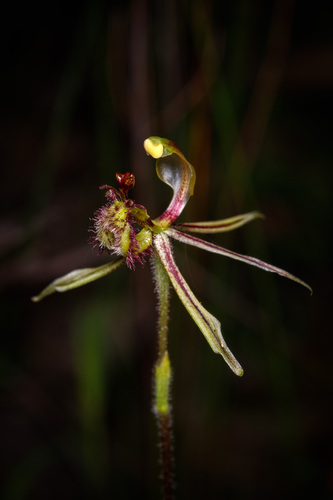
Caladenia barbarossa Rchb.f. is a terrestrial, perennial, deciduous herb that grows from an underground tuber. It produces a single hairy leaf, which is 40–60 mm (1.6–2.4 in) long and 5–10 mm (0.2–0.4 in) wide. In spring, it bears one, rarely two flowers at the top of a stalk that grows 100–300 mm (4–10 in) tall. Each flower measures 25–40 mm (1–2 in) long and 20–30 mm (0.8–1 in) wide, and is cream to greenish-yellow with red markings. The dorsal sepal is erect, 18–25 mm (0.7–1 in) long, and about 2 mm (0.08 in) wide. The lateral sepals spread apart below the flower, are 18–25 mm (0.7–1 in) long, and 2–5 mm (0.08–0.2 in) wide. The petals also spread widely, are slightly shorter and narrower than the sepals, and have inward-rolled tips. The labellum resembles the body of a wingless female thynnid wasp, and is stiffly hinged to the column. It has a dummy insect abdomen that is 8–10 mm (0.3–0.4 in) long, 6–8 mm (0.2–0.3 in) wide and curved, covered with many maroon hairs and calli. The false head is blackish, about 3 mm (0.1 in) wide, with two large, thick calli around 2 mm (0.08 in) long on either side of the "head". This species, commonly called common dragon orchid, is widespread and common across areas between Bindoon, Ravensthorpe and Esperance, within the Avon Wheatbelt, Esperance Plains, Jarrah Forest and Mallee biogeographic regions. It grows in sandy or clayey loams in moist locations across a wide range of habitats, and is especially common in Casuarina thickets. It is pollinated by male thynnid wasps that attempt to copulate with the flower. A male Thynnoides bidens has been photographed on the labellum of a Caladenia barbarossa flower.