About Cairina moschata (Linnaeus, 1758)
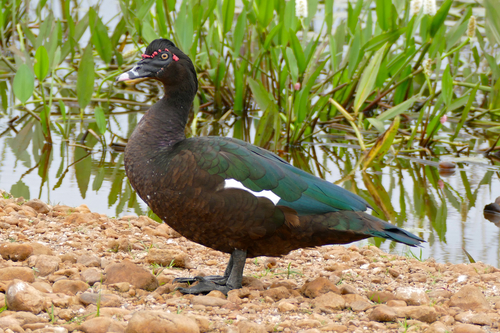
Cairina moschata, commonly called the Muscovy duck, is a large duck species with significant sexual dimorphism: males are notably larger than females. Males measure 76–84 cm (30–33 in) in length and weigh 3–4 kg (6.6–8.8 lb), while females measure 71–76 cm (28–30 in) in length and weigh roughly 1.25 kg (2.8 lb), about half the weight of males. The species has a total wingspan ranging from 137 to 152 cm (54 to 60 in). Wild Muscovy ducks have predominantly black plumage with large white patches on the wings. Back and wing feathers are iridescent and glossy in males, while female plumage is more drab. This species has long claws on its feet and a wide, flat tail. Males have a short crest on the nape of the neck. Their bill is black with pale pink speckling, and a blackish or dark red knob sits at the base of the bill, matching the color of the species' bare facial skin. Their eyes are yellowish-brown, and their legs and webbed feet are blackish. Females have similar plumage to males but are smaller, have fully feathered faces, and lack the prominent bill knob. Juvenile Muscovy ducks are duller overall, with little to no white on the wings. Male Muscovy ducks (drakes) produce a low breathy call, while female Muscovy ducks (hens) produce a quiet trilling coo. Domestic Muscovy ducks are commonly called pato criollo in Spanish. They have been bred by Native Americans since pre-Columbian times; they are heavier than wild birds and less able to fly long distances. Domestic Muscovy ducks also have more variable plumage, which often includes extensive white patches. Although the Muscovy duck is a tropical species, it adapts well to cooler climates, thriving in temperatures as cold as −12 °C (10 °F) and able to survive even colder conditions. In culinary contexts, C. moschata is generally referred to as the Barbary duck. This non-migratory species usually lives in forested swamps, lakes, streams, and nearby grassland and farm crops, and often roosts in trees at night. Its diet includes plant material such as roots, stems, leaves, and seeds of aquatic plants, grasses, and terrestrial plants (including agricultural crops), which it gets by grazing or dabbling in shallow water. It also eats small fish, amphibians, reptiles, crustaceans, spiders, insects, millipedes, and worms. Muscovy ducks are an aggressive species; males often fight over food, territory, or mates. Females fight with each other much less often. Some adult ducks will peck at ducklings when they feed from the same food source. The species has benefited from nest box programs in Mexico, but is somewhat uncommon across much of the eastern part of its range due to excessive hunting. It is not considered a globally threatened species by the IUCN, however, because it is widely distributed. Like mallards, Muscovy ducks do not form stable pairs. They mate on land or in water. Females lay a clutch of 8 to 15 white eggs, usually in a tree hole or hollow, and incubate the eggs for 30 to 31 days. The incubating female leaves the nest once per day for 20 minutes to one and a half hours to defecate, drink water, eat, and sometimes bathe. Once eggs begin to hatch, it can take up to 24 hours for all chicks to break through their shells. Feral chicks usually stay with their mother for about 10 to 12 weeks. Young Muscovy ducks cannot produce all the body heat they need, especially in temperate regions, so they stay close to their mother, particularly at night. The drake often stays in close contact with the brood for several weeks, walking with the young as they travel to search for food to provide protection. Anecdotal evidence from East Anglia, United Kingdom suggests that in response to different environmental conditions, other adult ducks help protect chicks and provide warmth at night. This behavior has been linked to local culling efforts targeting the feral Muscovy duck population, which led to an atypical ratio of males to females and young to mature birds. For the first few weeks of life, Muscovy chicks feed on grain, corn, grass, insects, and almost any small moving prey. Their mother teaches them how to feed from an early age.