About Caiman yacare (Daudin, 1801)
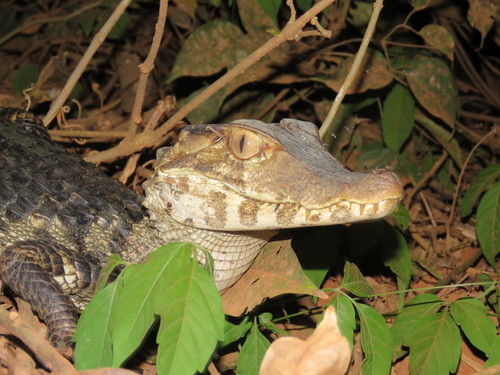
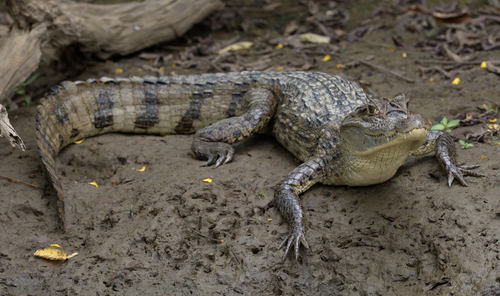
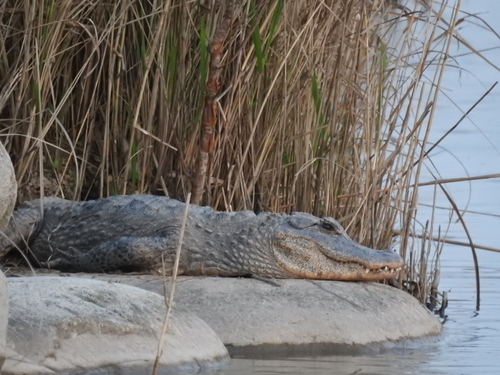
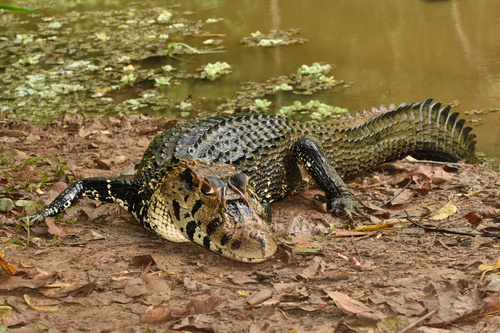
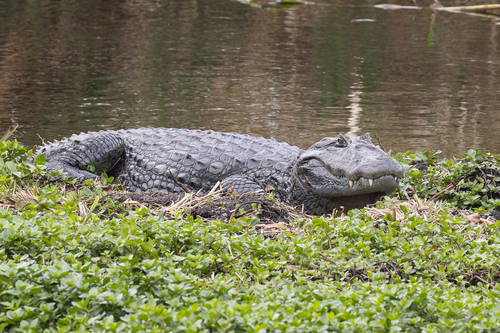
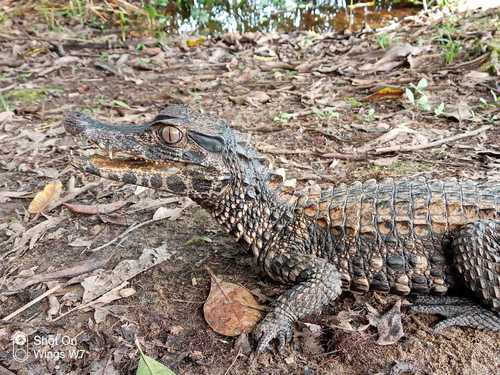
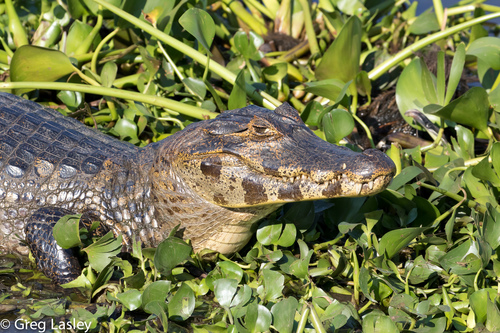
Caiman yacare (Daudin, 1801), commonly called the piranha caiman, is a medium-sized brown caiman. Adult males reach a total length (including tail) of 2–3 meters (6 ft 7 in – 9 ft 10 in) and can weigh up to 58 kg (128 lb), while adult females are much smaller at an average total length of 1.4 m (4 ft 7 in) and a weight of 14–23 kg (31–51 lb). Newly hatched females have an average snout–vent length (SVL) of 12.49 cm (4.92 in), and newly hatched males have an average SVL of 12.84 cm (5.06 in). A 1987 to 2013 study of multiple specimens in the Pantanal found that both sexes reach roughly 50 cm (20 in) SVL by age 5. Most individuals finish growing by age 15, at which point females reach approximately 80 cm (31 in) SVL and males reach over 100 cm (39 in) SVL. The study also confirmed that individual growth rates vary significantly between members of this species. Dark markings are spread across the caiman's body; the most distinct marking is three to five blotches covering its lower jaw. It has a medium-length, broad, smooth snout. It has lumps on its eyelids and a curved ridge between its eyes. Like the spectacled caiman, C. yacare has osteoderms embedded in its scales. On average, it has 74 teeth total: 5 pre-maxillary, 14–15 maxillary, and 17–21 mandibular teeth. Some lower jaw teeth can fit through grooves in the upper jaw, which makes these teeth more visible. This distinctive feature has been compared to piranhas, giving the species its common name "piranha caiman". The yacare caiman is distributed across northern Argentina, Bolivia, southern Brazil, and Paraguay. It is one of three Caiman species native to South America; the other two are the broad-snouted caiman (C. latirostris) and the spectacled caiman (C. crocodilus), which have more easterly and more northerly ranges respectively. It is one of the most common crocodilian species on the South American continent. Ecology of the yacare caiman is very similar to that of the spectacled caiman. It occupies semi-aquatic habitats including lakes, rivers, and wetlands, and can adapt to a wide range of other habitats. When their habitat is disturbed, groups of yacare caimans will sometimes move to new locations together. Its diet consists mainly of aquatic animals such as snails and fish, and occasionally includes snakes. It has also been recorded preying on capybaras. When hunting snails, it searches within floating aquatic vegetation and uses its jaws to break open snail shells. In July 1986, researchers examined a specimen from Bolivia and found its stomach contained mud along with small fragments of eggshell, which likely came from another caiman. It is a general behavior among crocodilians to consume their own species' eggshells after eggs have hatched. Breeding for C. yacare typically takes place between December and February, during the midpoint of the rainy season. Females build mound-shaped nests from mud and decaying vegetation. A clutch can contain up to 44 eggs, but most clutches number between 22 and 35 eggs, with clutch size often varying by habitat type. This species exhibits multiple paternity more frequently than many other crocodilian species. Females usually guard nests during incubation, but nest protection becomes less consistent in areas with high human hunting pressure. Reduced nest protection leads to lower hatching success rates. Eggs hatch in March. Hatchlings are precocial, meaning they receive very little parental care and must fend for themselves. Young caimans hide in grasses during the day to avoid predators such as herons and storks. Females reach sexual maturity between 10 and 15 years of age. The estimated maximum lifespan of C. yacare is around 50 years, based on the lifespan of similar caiman species, but the exact lifespan of this species is unknown.