About Caiman crocodilus (Linnaeus, 1758)
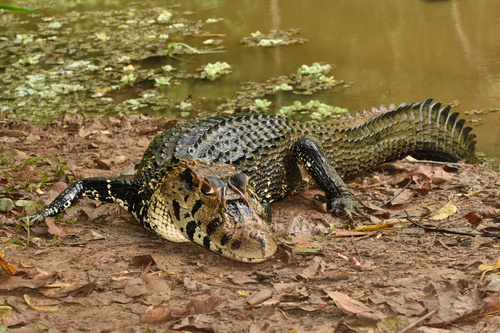
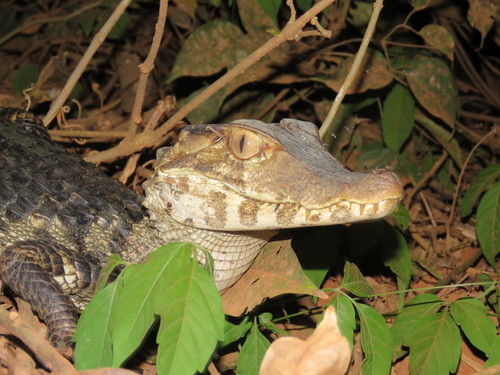
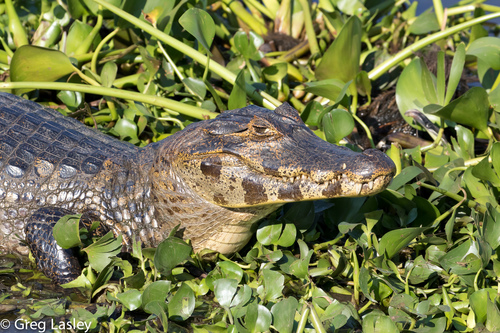
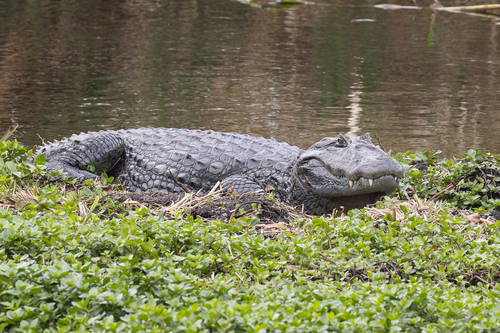
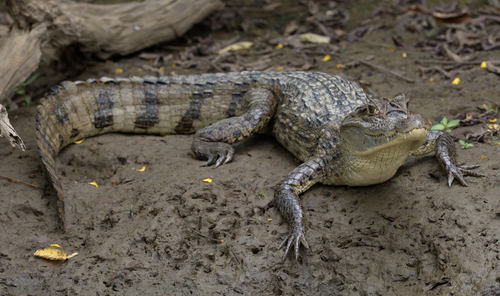
The spectacled caiman, Caiman crocodilus (Linnaeus, 1758), is a small to medium-sized crocodilian. Females generally do not grow larger than 1.08 to 1.4 m (3 ft 7 in to 4 ft 7 in), where the lower end of this range is typical size when sexual maturity first begins. Rarely, females can grow to nearly 2 m (6 ft 7 in). Adult males regularly reach 1.5 to 1.8 m (4 ft 11 in to 5 ft 11 in), while large mature males grow to 2.0 to 2.5 m (6 ft 7 in to 8 ft 2 in), though relatively few individuals reach the upper end of this size range. The maximum confirmed size recorded for the species is 2.64 m (8 ft 8 in). Most adult spectacled caimans weigh between 7 and 40 kg (15 and 88 lb), and males are typically considerably heavier than females. Some males in the Llanos have been recorded growing up to 58 kg (128 lb). The upperside of the body is mostly brownish-gray, greenish-gray, or yellowish-gray with dark brown crossbands, and the underside is lighter. The species has a greenish iris and wrinkled eyelids. Its color changes seasonally: during colder weather, black pigment within its skin cells expands, making the skin appear darker. It has an enlarged 4th tooth, and teeth in the lower jaw fit into sockets in the upper jaw. It has a long snout that tapers moderately, with an unexpanded tip. Several ridges run from the area in front of the eyes down to the tip of the snout. The species' common name comes from a bony ridge between its eyes that looks like a pair of spectacles. The spectacled caiman has the largest geographic range of any caiman, and of any New World crocodilian. It occurs across multiple countries in the Americas: Brazil, Colombia, Costa Rica, Ecuador, El Salvador, French Guiana, Guatemala, Guyana, Honduras, Mexico, Nicaragua, Panama, Peru, Suriname, Trinidad and Tobago, and Venezuela, and it may also still exist in Belize and Bolivia. In Brazil, the species lives in the Amazon, Araguaia, Araguari, Itapicuru, Rio Negro, Paranaíba, Solimões, Tapajós, Tocantins, and Xingu rivers. The species is intolerant of cold climates, so its range is unlikely to expand further north than Florida. It usually inhabits forests, inland freshwater bodies such as wetlands and rivers, grasslands, shrublands, and savannas, and is very adaptable. It prefers habitats with calm water that contains floating vegetation, and that usually floods and dries seasonally. It is most common in low-lying areas, but has been found at elevations up to 800 m (2,600 ft), and can survive in areas inhabited by humans. Spectacled caimans reach sexual maturity between four and seven years old, at a length of 1.2 metres (3.9 ft) for females and 1.4 metres (4.6 ft) for males. More dominant individuals usually mature more quickly. There is no strict reproductive hierarchy among spectakled caimans, but studies show larger males have higher breeding success. Mating and copulation occur between May and August, during the wet season. Females build mound-shaped nests from dense vegetation, in locations close to water that are not at risk of flooding. Nests are over 1 metre (3.3 ft) in diameter and can be 40 centimetres (16 in) high, though exact size depends on available resources. Eggs are laid in July and August; the species very rarely nests in winter, as temperatures are too low for egg development. Average clutch size is 22 eggs, ranging from 14 to 40 eggs total. Larger females have been recorded laying larger eggs than smaller females. Females stay near their nests during incubation, because multiple other species (such as lizards in the genus Tupinambis, white-nosed coatis, and foxes) destroy nests and prey on caiman eggs. Flooding and human egg collection are also threats to nests. A study in Central Amazonia comparing reproduction between C. crocodilus and Melanosuchus niger found that spectacled caimans space their nests further apart than other caiman family species, most likely to avoid predation. Temperature is critical for developing eggs, so females build nests to insulate eggs from extreme temperature changes. As the vegetation in the nest decays, it generates heat that keeps eggs roughly 5 °C (9 °F) warmer than they would be if insulated only by mud. Heat both incubates the eggs and determines the sex of developing caimans through temperature-dependent sex determination: when internal nest temperature is roughly 32 °C (90 °F) or higher, hatchlings will be female; at lower temperatures, hatchlings will be male. Young caimans hatch after 90 days, with only 20–25 percent of eggs successfully hatching. Hatchlings are yellow with black spots, a patterning that fades as they grow, and measure 20–23 centimetres (7.9–9.1 in) long at hatching. Adult spectacled caimans raise their young in communal crèches, where one female cares for her own offspring alongside the young of other individuals. Care for young lasts 12–18 months. Young caimans face threats from many predators, including raptors like hawks, wading birds like herons, large fish, large snakes like anacondas, and other crocodilians, so most young die within their first year.